Micah 6:1-8
Psalm 15
Matthew 5:1-12
As I read these passages this week one word remained in my mind, humility. Of course the word appears in the Micah text. Yet in various ways both Paul, in Corinthians, and Jesus, with this passage called the Beatitudes, are speaking about humility. However, I wish to be careful. I do not want to extend a discourse that has been used to keep certain people in their place. In some sense the language of humility can and has been used as exclusively for the other. Others are to humbly submit. In this discourse there is a subtle but key distortion of the Biblical language of humility. I will begin by addressing this distortion, that is addressing myself as one privileged in our society, as one who is generally not exhorted to be humble, that is as white and male.
Micah addresses quite directly this distortion. God brings charges against Israel, that is the representatives of Israel. Read the powerful the privileged, those in positions of authority, to those of us who White those of us who have a high level of education even if in some ways we may also be members of less privileged classes. I hear God say to us there is a case against us the white European Christians, to the powerful and those who benefit from the powerful. God comes and has a case against us.
Perhaps we say okay God (as the representative of Israel does) your right, what do I need to do. Do I need to give away more of my money, do I go on protests, do I demand that the government support higher standards of morality and responsibility from the Poor. Do I get arrested for a cause, do I take my family to a war zone and put them in harms way?
These are not exactly analogous to the list in Micah, since the spokesperson for Israel speaks the abominable to God human sacrifice. Though, perhaps he is remembering the binding of Isaac, and Abraham’s radical obedience. So perhaps this representative of Israel is simply asking what radical sacrifice will make him right with God.
In the face of what is so often clearly the failure of the church to witness to Christ and the Gospel we too run about asking God what do I do; is it this, or this or maybe it’s advocating for this or that, and we will argue amongst ourselves Liberal conservative, traditionalist/progressive. We all are very actively trying to repair what we have so clearly messed up.
Yet God in his chaotic courtroom seeks silence, pounding his gavel trying to get our attention. “Hold on you don’t need to ask questions you don’t need to run around and argue amongst yourselves. You already know what it is I require. This ain’t a secret folks. I have said it all long. What I require is to do justice to love hesed (mercy/kindness) and to walk humbly with your God. That is it, no sacrifice, no placing you and your family in harms way, no set of programs, social or moral. You the privileged and powerful be just in your dealings do what is just, love mercy/kindness. Walk with me as your God. Be humble submit to my ways and me.” Granted the sacrifices and other things will follow from this but it must begin with admitting that all comes from God your power your privilege your identity has its origin in God. Live according to that truth.
In essence to do justice and to love kindness and to be humble before God are the same thing. If we all lived this way in the Church in our nations political life, if we lived this way in every encounter with the homeless, with confronting corruption and immorality in our neighborhoods city and country, what the world would be like?
Jesus envisioned such a world. Now I should warn you Jesus in the passage before us isn’t talking to the privileged though I think Mathew’s take on Jesus’ words here does attempt to broaden their application.
Jesus places in front of us the radical release of the will and self-assertion. All of these are about the release of the grasping after our own self-identity.
This causes some discomfort especially when Mathew account is compared to Luke's. Matthew some argue is spiritualizing, and undermining Jesus’ preferential option for the poor. Matthew it can be argued leaves us without means to resist oppression and in fact hands the oppressor the very tools he needs to “Christianize” his oppression. I agree that a certain reading of Matthew’s beatitudes has been used for the perpetuation of oppression. Yet, what is not taken into account that if God has a “preferential option for the poor” it is because God is radically opposed to the ways of the World, its Powers and its structures and speech of power. For the powerful there is no such thing as a good poverty, except in the other. Mercy and meekness are weakness. Righteousness is the right to do as one pleases; one is pure of heart if one deals fairly with those with whom one does business. If you are treated unfairly you sue, or retaliate in some form. The world interprets the Beatitudes in terms of self-interest. Yet, The beatitudes are directed away from the self. The radical reality of this is that if oppressor and oppressed each practiced these virtues toward the other, there could be no exploitation no wealth created on the backs of day laborers, slaves, migrant workers, no violent revolution, no cycle of violence. People who exhibit these traits are blessed because in the practice of these virtues the Kingdom of God is manifest. The reversal comes in the practice of poverty, of morning, of hungering, of peacemaking, of not seeking to self identify. This is brought home in the last beatitude Christ does not tell us his disciples that we are blessed if we are persecuted for our own identity, for being this or that for being alternative or for the poor or for democracy, or whatever other way the world seeks to have us identify but If persecuted because of our identity with Jesus for the name of Christ. If you walk humbly with Christ bearing his name, abandoning all other identities if for that one identity you are persecuted, great is your reward.
In a sense one might say that the beatitudes are simply a commentary on our Micah passage. Taken together with Micah what this passage says to the powerful is not “tell the poor and weak” to humbly submit to your will and do as they told, but to let go of power, to seek the good of the other. To the poor and the oppressed Jesus offers a way of righteous resistance that refuses the oppressors language of power and control and identity. For the violence to end both sides must relinquish self. Jesus isn’t sanguine here. He knows where these virtues will lead his flock, to the cross: to persecution and slander. Jesus doesn’t deny the reality of the Worlds power and violence. He does claim that the solution is never the grasping of power or the rejection of humility even if the World humiliates.
According to Jesus if we resist the world if we turn aside from its injustice we do not do so in order to assert our selves and our identities. The Worlds solution to oppression is precisely this terrain of competing identities in an arena of controlled violence, where there are winners and losers. We are then to argue over whether the loser’s loose because of the system or their own fault, and to what degree does the Government need to protect the losers from the winners.
Paul proclaims that this worldly wisdom is confounded by the logic of the Cross. If Mathew’s beatitudes seem a bit like pie in the ski and Micah’s presentation of God’s word to the powerful as wishful thinking, Paul gives us the solution, the basis of what Mathew and Micah present to us as God’s word.
My brother’s and sister’s the good news of Jesus Christ is the Cross. God’s wisdom is found in Christ’s life as the way to the Cross. God comes to a backwater part of the world lives out life as a human being and submits to brutal capital punishment. All, poor, rich, White, Black, Hispanic, Asian, Third, World, First World, homosexual, heterosexual, gay, straight, male female… I could list out the identities out infinitely, end up here before the Cross. We all end up before the Crucified one who is God’s Son the Word the Second person of the triune God. We face God’s own self, given for each one of us.
It is all consummated in the Lord’s Supper, Communion, the Eucharist. This, what we do here, what Christians have done for two thousand years and it is foolishness to the World. We are judged when we as Christians fail to recognize this and then seek to live into the wisdom of the world and its identities, its dynamics of power, and its rejection of humility.
The way of God, in which we are to humbly walk is the way of the Cross. The way of the Cross is the beatitudes: a leaving ourselves aside for others and the Other, God. Christ’s teachings, the preferential option for the poor, the ethical demands of Jesus, and the law and the prophets are all without power separated from the way of the Cross. All our sacrifices all our endeavors even if seemingly wise and good to the World are foolishness to God if we have not first submitted to the way of the Cross, giving up ourselves, our privilege or our right to self-identify or both. This is the wisdom of God though it is foolishness to our culture and its politics of power and right. Without the Cross, we are alone each one of us looking out for our own rights. Or we are seeking to give access to others the privileges we have but which have been gained by violence.
At the Cross God takes up humanity in God’s arms and says hush. Stop, here is the truth of your existence stop all your striving. Stop, it is so simple here is all that I require; to stand and identify with me at the point that I give you everything and I take on all your failures all your alienation all your self-exultation. This is God, Crucified as a common Criminal for you. This is love. This is truth. This is power. This is wisdom. All else is nothingness. Here all truth is spoken, the law and the prophets fulfilled, the proclamation of the apostles the Good news of Jesus Christ of the Kingdom of God is summed up, all is said. There is nothing else. Shh, be still.
Monday, January 31


Tuesday, January 25
Sermon - Third Sunday After Epiphany
Isaiah 9:1-4
Psalm 27:1, 4-9
1 Corinthians 1:10-18
Matthew 4:12-23
I was in college. I remember that it was cold. It was an Easter sunrise service. It was a rare thing for it to be cold. The Baptist Student Union was having its service out in the gazebo on the lake. Cold weather is a rare thing at Easter. It must have been early that year. Usually the azaleas are out, the dogwood are in bloom. Easter is a glorious time.
I remember that I was sitting, looking at the water...And then I had a vision. In the vision was a light. It was undulating like some living thing, a giant amoeba. It was surrounded by darkness, the kind of darkness that is limitless. The light could not penetrate it...or so it seemed. Tendrels of light reached out and at the end of each tendrels was a person, each in their own way was making their own way toward the light, being led out of darkness and into the light's embrace.
And so I sat there wondering why we are Baptist. I wondered why we made the distinction. Others were celebrating Easter and we had divided ourselves, separated ourselves. It made no sense to stand alone or segregated into our little tradition when we are all on the same journey.
I share this with you so you will all understand a little better why I am so passionate about the ecumenical vision of our congregation. Today's readings reminded me of this vision.
The Corinthians passage always makes me laugh. What is Paul talking about? Did he baptize those people or not? It is like Paul is showing his age or something. He wearily goes off on some tangent about who he might or might not have baptized. He sounds confused. A couple of the commentators I read preparing for this sermon suggest that Paul is so flustered by the situation at the church in Corinth that he is incapable of remembering who he baptized. He’s just that mad.
When I read this passage, I can almost hear him saying "I did baptize also the household of Stephanas; beyond that, I do not know whether I baptized anyone else...but that's bedside the point. Gosh. What was I talking about? Boy, you people! You see... Christ did not send me to baptize but to proclaim the gospel, and, apparently, not with eloquent wisdom, so that the cross of Christ might not be emptied of its power. For the message about the cross is foolishness to those who are perishing, but to us who are being saved it is the power of God."
It is not a great leap in a congregation like ours when we are already thinking about ecumenism to think that Cephas, and Apollos or even Paul himself could be John Calvin or Martin Luther or any number of Baptists…the list could go on and on. It should be an easy leap to hear "denominationalism" or "factionalism" when we are presented with the troubles at Corinth. Like the church then, the church today is divided.
And in response to that disunity. Paul suggests a means for unity. He recognizes the disunity. He understands how it happens. Paul recognizes the temptation to turn our faith into a club or an association of some kind where we are concerned about allegiances to a patron (Cephas, Apollos or even Paul himself) or an allegiance to an institution above all else.
For Paul, the means for unity in the church is the cross. It is through foolishness, through humble submission to Christ that we can achieve unity. In chapter three of the letter to the Corinthians Paul sums it all up for me. "21So let no one boast about human leaders. For all things are yours, 22whether Paul or Apollos or Cephas or the world or life or death or the present or the future—all belong to you, 23and you belong to Christ, and Christ belongs to God."
I believe that this is the attitude that we attempt to live into here at Reconciler. It is not that Paul is suggesting we ignore Cephas or Apollos or, heaven forbid (!), Paul himself. Oh no. Paul has too much more to say to all involved to care to be ignored. But he does tell us whose we are, and, in the end, to whom we belong.
The discipline I am learning is to not brag about being Baptist, to not insist that being Baptist is the best and only way to be Christian. Or even the only way I can be Christian. I am having to reshape my thinking. It may be that, though I am Baptist, and I express a certain loyalty to being Baptist, the fundamental reality is that the church is about Christ. Paul says that the church is Christ. I cannot proclaim Baptist identity, as precious as it might be, as if it were a substitution for being Christian.
This has been my work as a pastor in this ecumenical congregation. To bring about unity, to bring about reconciliation, I have had to sacrifice some of my identity as a Baptist in order to claim my identity as a Christian. Perhaps this is not your stumbling block, but it has been mine. I must confess that this was a revelation of sorts to me. I realize now that I have spent far too much time arguing and debating. I cannot tell you how many times I said in seminary "But as a Baptist…" It has been hard to learn to speak about Jesus and not about being Baptist.
In ecumenical work, this, I believe, is the task we must all take on as our own. The Princeton Proposal for Christian Unity says it better than I can:
The fruits of this discipline have been numberless. This humility and self-giving has been nurturing to us all here at Reconciler. Through what may appear foolish, worship life is enriched, deepened, by our willingness to let go of our particular (and perhaps peculiar) identities and seek that which is of Christ and one another as members of Christ’s body. It is not as if Paul and Cephas and Apollos are going anywhere. They too are members of the one body. The riches of our traditions are embraced by Christ himself. Now they do not serve as stumbling blocks but as stepping stones. Now they are gifts to one another for the sake of our shared salvation through the cross. This is good news!
The people who walked in darkness have seen a great light;
those who lived in a land of deep darkness on them light has shined.
God has multiplied the nation,
God has increased its joy.
Rejoice before God as with joy at the harvest, as people exult when dividing plunder.
For the yoke of our burden, and the bar across our shoulders, the rod of our oppressor, has been broken as on the day of Midian.
That light that shines is the light of Christ.
That light shines into the dark places of the world.
That lights shines into places of disunity
That light shines into places of oppression.
That light shines into denominational offices.
That light shines into regional offices, diocese and conferences warming hearts and enlivening minds.
That light shines into this congregation.
That light shines into our homes.
That light shines into our hearts long made hard by fear and distrust.
Disunity cannot stand. Have hope in the cross. Have hope in the way of Jesus. Let no one boast about human leaders. For all things are yours, whether Paul or Apollos or Aquinas or Luther or Calvin or Bonhoeffer or Fiorenza or Barth or King or Cephas or the world or life or death or the present or the future—all belong to you, and you belong to Christ, and Christ belongs to God.
No church is a utopia. No denomination is either. No home, no family…strife exists. But we, we who follow Christ know how to meet strife and disunity. Humility and self-giving are God’s gifts to us so that we may be Christ to one another, in our homes, in this place and in all the world.
May God grant us peace and unity now and always.
Amen.
Psalm 27:1, 4-9
1 Corinthians 1:10-18
Matthew 4:12-23
I was in college. I remember that it was cold. It was an Easter sunrise service. It was a rare thing for it to be cold. The Baptist Student Union was having its service out in the gazebo on the lake. Cold weather is a rare thing at Easter. It must have been early that year. Usually the azaleas are out, the dogwood are in bloom. Easter is a glorious time.
I remember that I was sitting, looking at the water...And then I had a vision. In the vision was a light. It was undulating like some living thing, a giant amoeba. It was surrounded by darkness, the kind of darkness that is limitless. The light could not penetrate it...or so it seemed. Tendrels of light reached out and at the end of each tendrels was a person, each in their own way was making their own way toward the light, being led out of darkness and into the light's embrace.
And so I sat there wondering why we are Baptist. I wondered why we made the distinction. Others were celebrating Easter and we had divided ourselves, separated ourselves. It made no sense to stand alone or segregated into our little tradition when we are all on the same journey.
I share this with you so you will all understand a little better why I am so passionate about the ecumenical vision of our congregation. Today's readings reminded me of this vision.
The Corinthians passage always makes me laugh. What is Paul talking about? Did he baptize those people or not? It is like Paul is showing his age or something. He wearily goes off on some tangent about who he might or might not have baptized. He sounds confused. A couple of the commentators I read preparing for this sermon suggest that Paul is so flustered by the situation at the church in Corinth that he is incapable of remembering who he baptized. He’s just that mad.
When I read this passage, I can almost hear him saying "I did baptize also the household of Stephanas; beyond that, I do not know whether I baptized anyone else...but that's bedside the point. Gosh. What was I talking about? Boy, you people! You see... Christ did not send me to baptize but to proclaim the gospel, and, apparently, not with eloquent wisdom, so that the cross of Christ might not be emptied of its power. For the message about the cross is foolishness to those who are perishing, but to us who are being saved it is the power of God."
It is not a great leap in a congregation like ours when we are already thinking about ecumenism to think that Cephas, and Apollos or even Paul himself could be John Calvin or Martin Luther or any number of Baptists…the list could go on and on. It should be an easy leap to hear "denominationalism" or "factionalism" when we are presented with the troubles at Corinth. Like the church then, the church today is divided.
And in response to that disunity. Paul suggests a means for unity. He recognizes the disunity. He understands how it happens. Paul recognizes the temptation to turn our faith into a club or an association of some kind where we are concerned about allegiances to a patron (Cephas, Apollos or even Paul himself) or an allegiance to an institution above all else.
For Paul, the means for unity in the church is the cross. It is through foolishness, through humble submission to Christ that we can achieve unity. In chapter three of the letter to the Corinthians Paul sums it all up for me. "21So let no one boast about human leaders. For all things are yours, 22whether Paul or Apollos or Cephas or the world or life or death or the present or the future—all belong to you, 23and you belong to Christ, and Christ belongs to God."
I believe that this is the attitude that we attempt to live into here at Reconciler. It is not that Paul is suggesting we ignore Cephas or Apollos or, heaven forbid (!), Paul himself. Oh no. Paul has too much more to say to all involved to care to be ignored. But he does tell us whose we are, and, in the end, to whom we belong.
The discipline I am learning is to not brag about being Baptist, to not insist that being Baptist is the best and only way to be Christian. Or even the only way I can be Christian. I am having to reshape my thinking. It may be that, though I am Baptist, and I express a certain loyalty to being Baptist, the fundamental reality is that the church is about Christ. Paul says that the church is Christ. I cannot proclaim Baptist identity, as precious as it might be, as if it were a substitution for being Christian.
This has been my work as a pastor in this ecumenical congregation. To bring about unity, to bring about reconciliation, I have had to sacrifice some of my identity as a Baptist in order to claim my identity as a Christian. Perhaps this is not your stumbling block, but it has been mine. I must confess that this was a revelation of sorts to me. I realize now that I have spent far too much time arguing and debating. I cannot tell you how many times I said in seminary "But as a Baptist…" It has been hard to learn to speak about Jesus and not about being Baptist.
In ecumenical work, this, I believe, is the task we must all take on as our own. The Princeton Proposal for Christian Unity says it better than I can:
If the ecumenical project of modern Christianity is to move forward. Unity will require our churches not only to renounce the selfishness and insularity that we all dislike and easily see as sinful. It will also require our churches to embrace a spiritual poverty that has the courage to forego genuine riches of a tradition for the sake of a more comprehensive unity in the truth of the gospel. [The disciplines of unity are penitential. As St. Paul teaches, for the sake of unity, we must be willing to suspend gospel freedom and conform to the limitations of the weak. This process will be ascetical; it will necessarily involve that sacrifice of real but limited goods for the sake of the greater good.]Like Christ, we must lay down our own lives, our institutional lives in order to serve one another and to bring unity, a real and present unity.
The fruits of this discipline have been numberless. This humility and self-giving has been nurturing to us all here at Reconciler. Through what may appear foolish, worship life is enriched, deepened, by our willingness to let go of our particular (and perhaps peculiar) identities and seek that which is of Christ and one another as members of Christ’s body. It is not as if Paul and Cephas and Apollos are going anywhere. They too are members of the one body. The riches of our traditions are embraced by Christ himself. Now they do not serve as stumbling blocks but as stepping stones. Now they are gifts to one another for the sake of our shared salvation through the cross. This is good news!
The people who walked in darkness have seen a great light;
those who lived in a land of deep darkness on them light has shined.
God has multiplied the nation,
God has increased its joy.
Rejoice before God as with joy at the harvest, as people exult when dividing plunder.
For the yoke of our burden, and the bar across our shoulders, the rod of our oppressor, has been broken as on the day of Midian.
That light that shines is the light of Christ.
That light shines into the dark places of the world.
That lights shines into places of disunity
That light shines into places of oppression.
That light shines into denominational offices.
That light shines into regional offices, diocese and conferences warming hearts and enlivening minds.
That light shines into this congregation.
That light shines into our homes.
That light shines into our hearts long made hard by fear and distrust.
Disunity cannot stand. Have hope in the cross. Have hope in the way of Jesus. Let no one boast about human leaders. For all things are yours, whether Paul or Apollos or Aquinas or Luther or Calvin or Bonhoeffer or Fiorenza or Barth or King or Cephas or the world or life or death or the present or the future—all belong to you, and you belong to Christ, and Christ belongs to God.
No church is a utopia. No denomination is either. No home, no family…strife exists. But we, we who follow Christ know how to meet strife and disunity. Humility and self-giving are God’s gifts to us so that we may be Christ to one another, in our homes, in this place and in all the world.
May God grant us peace and unity now and always.
Amen.
Weekly Update January 26, 2005
Weekly Update:
"The people who walked in darkness have seen a great light; those who lived in a land of deep darkness on them light has shined." Isaiah 9:2
"The people who walked in darkness have seen a great light; those who lived in a land of deep darkness on them light has shined." Isaiah 9:2
The days have been getting longer again and is now beginning to be noticeable. These seasonal changes of light and darkness are almost unnoticable from day to day are. One day we suddenly notice that it is light again in the early evening hours, or dark again. Yet these changes are happening every day.
Is it possible that the seasonal changes in light have something to teach us about the coming light of Christ, of the work of God in the World, and of our inability to notice the darkness in our own hearts?
As we sit for a time in the light of the Epiphany and wait for the journey of Lent, the journey of the Cross, are we training ourselves to notice the subtle advance of the light of Christ? We live in an instantaneous culture, in a culture of Blockbuster movies of with spectacle. In film and TV evil is obvious and sinister (rarely inviting or tempting) and defeat of evil is overwhelming and triumphant and decisive (until the next villain comes around). There is little in our culture that tunes our selves to the subtle changes, the slow advance of light in the world. (There is even perhaps a fascination with darkness).
God often works more like the subtle changes in the light through the seasons than the spectacular defeat of evil portrayed in our movies. Jesus first comes as a little baby, and then nothing much happens until Jesus appears on the scene as an adult to be baptized by John. Then all of Jesus works, his healing his gathering of disciples, the casting out of demons is all done on the way to the cross. Not so spectacular and not very triumphant. Yet the light came to the darkness and the darkness could not overcome it.
Monday night four of us, Kate, Justin, Tripp and Larry went out to Lombard to Northern Baptist Seminary for a meeting of “Emergent Church” types, called Up/rooted. Geoff Holsclaw is one of the coordinators of this group and has been one of our conversation partners as we have begun this church. The conversation was good, and continued participation with this group should prove fruitful as we continue to seek God’s leading. We hope our presence was encouraging to those present as well.
Lent is right around the corner, and we will be marking the beginning of lent with an Ash Wednesday service, February 9, to be held at the Community of the Holy Trinity at 7 PM. The community of the Holy Trinity is located at 6443 N. Bosworth apt. #2. Also, the Community of the Holy Trinity would like to invite any who would be interested in weekday evening prayer services to join the community in their evening prayer Monday, Tuesday and Thursday at 6:30 PM beginning February 7.
Wednesday, January 19
Weekly Update
"Taste and see that the Lord is good; Happy are all who find refuge in God."
In the past few weeks on our journey as an ecumenical congregation, God has brought us words on tasting and seeing (through the words of Tripp and Jane, respectively). These are appeals to our senses. These exhortations are metaphorical or, perhaps better, anological uses of language. That is to say that tasting and seeing aren't simply about biology, simple hedonistic enjoyment. Rather, tasting and seeing (our biology) participate in a deeper broader reality.
When Jesus in this week's Gospel calls us to come and see, he calls us to see with our eyes, yes; but also with another sight. Simply seeing did not answer all the questions. John saw and still comes back after his arrest asking Jesus if he is the one or not.
"He who has ears to hear."
We all have tongues and noses, ears and eyes, but our call as believers in Christ, as those baptized into the body of Christ, is to hone our senses-- to discipline our bodies that we may truely taste and see and hear. That our bodies would in truth participate in that reality, which is the medium of our existence. So that our bodies may fully participate in the reality of the Kingdom of God.
Similarly, as we write our consititution and register as a not-for-profit religious corporation in the State of Illinois, we are called to look into the larger realities. Our constitution and our legal status are not simply secular things of the World. That is, we are to seek in these things how the law and institution are expressions of, participations in the ordered reality God intends. Reconciler exists because we believe that the unity of the church is hindered as long as we remain in our separate institutions and denominations. The unity that is the reality of the One Church, must be expressed and visible.
As we move rapidly towards Lent our 5:30 gathering time will be devoted to seeking God in prayer. Durring Lent we will be using that time for a series on what it means for us to be an ecumenical congregation.
All that we do needs to be oriented towards seeking to live into the actual reality that God is calling us into as this particular congregation. We do not seek some "spiritualized" unity of Christians, as if taste, sight, bodies and institutions do not share in the reality of the kingdom. Rather we understand that all is to be redeemed and to be brought into subjection to Christ; all is to show forth the Glory of God. If in our denominations and institutions the "bodily" aspect of the church fails to show forth the glory of God, it is not necessarily because those things are evil; perhaps it is because we as Christians have failed to see how they participate in the fullness of God.
May the Peace of God, be with you now and always. Amen
Pastoral Team
In the past few weeks on our journey as an ecumenical congregation, God has brought us words on tasting and seeing (through the words of Tripp and Jane, respectively). These are appeals to our senses. These exhortations are metaphorical or, perhaps better, anological uses of language. That is to say that tasting and seeing aren't simply about biology, simple hedonistic enjoyment. Rather, tasting and seeing (our biology) participate in a deeper broader reality.
When Jesus in this week's Gospel calls us to come and see, he calls us to see with our eyes, yes; but also with another sight. Simply seeing did not answer all the questions. John saw and still comes back after his arrest asking Jesus if he is the one or not.
"He who has ears to hear."
We all have tongues and noses, ears and eyes, but our call as believers in Christ, as those baptized into the body of Christ, is to hone our senses-- to discipline our bodies that we may truely taste and see and hear. That our bodies would in truth participate in that reality, which is the medium of our existence. So that our bodies may fully participate in the reality of the Kingdom of God.
Similarly, as we write our consititution and register as a not-for-profit religious corporation in the State of Illinois, we are called to look into the larger realities. Our constitution and our legal status are not simply secular things of the World. That is, we are to seek in these things how the law and institution are expressions of, participations in the ordered reality God intends. Reconciler exists because we believe that the unity of the church is hindered as long as we remain in our separate institutions and denominations. The unity that is the reality of the One Church, must be expressed and visible.
As we move rapidly towards Lent our 5:30 gathering time will be devoted to seeking God in prayer. Durring Lent we will be using that time for a series on what it means for us to be an ecumenical congregation.
All that we do needs to be oriented towards seeking to live into the actual reality that God is calling us into as this particular congregation. We do not seek some "spiritualized" unity of Christians, as if taste, sight, bodies and institutions do not share in the reality of the kingdom. Rather we understand that all is to be redeemed and to be brought into subjection to Christ; all is to show forth the Glory of God. If in our denominations and institutions the "bodily" aspect of the church fails to show forth the glory of God, it is not necessarily because those things are evil; perhaps it is because we as Christians have failed to see how they participate in the fullness of God.
May the Peace of God, be with you now and always. Amen
Pastoral Team
Tuesday, January 18
Leave of absence
Sometimes things get busy, in the life of a seminarian; right now, that's the case with me.
I am currently involved in a quarter of field education-- an internship of sorts, designed to give us a taste of what is involved in the day-to-day running of the parish, and to allow us the opportuniity to pick the brains of willing and experienced priests, as we begin to shape how our ministries will be lived out. I am blessed to be working with two parishes over in my home diocese of Northern Indiana, serving each part-time. It's a wonderful experience, but it keeps me hopping.
Add to that my work with our little congregation here, and a class I'm taking as the last academic requirement for graduation, and the joyful demands of husband and family, and I'm finding that the press of responsibilities is more than I can manage. Something needs to give; and blessedly, Tripp and Larry have encouraged me to make the space I need by taking a leave from my responsibilities with Reconciler for the next couple of months.
We will stay in touch via phone and email (and this blog, of course!); but unless unforeseen circumstances arise, I will not be making the drive north for worship or other church activities.
Please know that I will continue to hold our faithful community in my prayers, both in thanksgiving and intercession, and that I am looking forward to returning to a more active role in our life together, toward the end of March.
God's grace and peace be with all of you!
I am currently involved in a quarter of field education-- an internship of sorts, designed to give us a taste of what is involved in the day-to-day running of the parish, and to allow us the opportuniity to pick the brains of willing and experienced priests, as we begin to shape how our ministries will be lived out. I am blessed to be working with two parishes over in my home diocese of Northern Indiana, serving each part-time. It's a wonderful experience, but it keeps me hopping.
Add to that my work with our little congregation here, and a class I'm taking as the last academic requirement for graduation, and the joyful demands of husband and family, and I'm finding that the press of responsibilities is more than I can manage. Something needs to give; and blessedly, Tripp and Larry have encouraged me to make the space I need by taking a leave from my responsibilities with Reconciler for the next couple of months.
We will stay in touch via phone and email (and this blog, of course!); but unless unforeseen circumstances arise, I will not be making the drive north for worship or other church activities.
Please know that I will continue to hold our faithful community in my prayers, both in thanksgiving and intercession, and that I am looking forward to returning to a more active role in our life together, toward the end of March.
God's grace and peace be with all of you!
Sunday, January 16
Sermon - Second Sunday after Epiphany
John 1:29-42
One of the first things you might notice about me is that I wear glasses. I got them when I was 9 years old, and in the fourth grade. My teacher noticed me squinting at the board and sent me to the school nurse, who made me look in the big machine with all the E’s pointing in the different directions. She sent a note home to my parents, who took me to the doctor, who gave me glasses. 30 some-odd years later I’m still wearing them, because I’m still nearsighted-- anything further than a few feet away becomes awfully fuzzy. I pretty much wear them all the time, unless I’m reading or asleep. Otherwise I’d be tripping over my own feet far more often than I already do. I need them to see.
Today’s gospel talks a lot about seeing things. It even begins there, with John the Baptist seeing Jesus coming toward him. He’s all wound up, as only John can get-- but who can blame him? This is the son of God, the one upon whom the spirit of God descended like a dove. Can you imagine having witnessed that, having been part of it? I’d be talking up that story too-- going on for days, likely.
That’s just what John does-- he’s still talking about it the next day, enough that a couple of his disciples go to check things out. And what does Jesus say, when they approach him?
“Come and see.”
What a contrast, between the cousins! John’s ranting and raving, his excited proclamation and carrying on... and then Jesus’ simple invitation.
“Come and see.”
But there’s something else I notice here. John’s witness is right out there-- what you see is what you get. It’s easy to take in, to take at face value.
On the other hand, Jesus’ invitation is more than it first appears to be. This isn’t only an offer to check out his apartment. It’s not about sightseeing, or spectator sport. In fact, it has very little to do with any kind of thing I might see, with or without these glasses. It’s about what a friend of mine calls “Kingdom Vision.”
What’s Kingdom vision? One of my very favorite stories in scripture illustrates this well. Do you remember the story of the sinful woman, who washes Jesus’ feet with her tears, and dries them with her hair? It’s in the 7th chapter of Luke. Simon the pharisee, who invited Jesus to dinner, is appalled-- not only by the presence of this notorious sinner in his home, but by the fact that Jesus would allow her to touch him. And eventually Jesus turns to him, and asks, “Do you see this woman?” Can you look beyond the surface, beyond the reputation, beyond the sobbing figure? Will you look not with human eyes, but with Kingdom eyes? Do you see there before you a precious child of God, beloved and restored and forgiven?
“Come and see,” Jesus says, the master of Kingdom vision. And it sounds so simple, doesn’t it? Just three little words. But like so many things, easier said than done. We are all so very human, and it’s so easy to get caught up in our own... well, nearsightedness, or farsightedness, or astigmatism, or blind spots. To stop short, and to fall into judging ourselves, and one another, by external standards. We see male or female; gay or straight; black, white, hispanic or asian; corporate blue suit and crewcut or pink hair and tattoos, and we think we have a handle on understanding one another. These things are part of who we are, certainly, but if we stop there, we only scratch the surface. We’ve not really even begun to see, not as Jesus sees.
Martin Luther King Jr., in his famous “I Have a Dream” speech, goes a bit further. In it, he expressed the hope that one day his children “would be judged not by the color of their skin, but by the content of their character.” This is a laudable goal, and one that reaches deeper, certainly. But think about this-- when considered in light of the gospel, does that go far enough? With all due respect to Dr. King, I don’t believe it does. Scripture tells us that “all have sinned and fallen short of the glory of God.” We all have places where the content of our character... is lacking. In fact, that’s where the nearsightedness lives: our ability to pick at faults and miss virtue; to make assumptions, and not see beyond them. And if we judge one another by that lack, that incompleteness in character, aren’t we still missing the mark?
But here’s the good news, brothers and sisters. Kingdom vision, by the grace of God, doesn’t stop there; not even close. Kingdom vision strives to see through all those layers, past all the wrongheaded misunderstanding, and gaps in judgment, and sinful choices. Kingdom vision sees, as the song says, with the eyes of our hearts. And the more we work to love the Lord, and to answer Jesus’ gentle invitation to “come and see,” the more we begin to see with our Kingdom eyes. As our baptismal covenant says, to “seek and serve Christ in all persons,” and to “respect the dignity of every human being.” Dignity that is inherent to our souls, by the indwelling of the Spirit in each and every one of us.
Come and see, my brothers and sisters. Come and see.
One of the first things you might notice about me is that I wear glasses. I got them when I was 9 years old, and in the fourth grade. My teacher noticed me squinting at the board and sent me to the school nurse, who made me look in the big machine with all the E’s pointing in the different directions. She sent a note home to my parents, who took me to the doctor, who gave me glasses. 30 some-odd years later I’m still wearing them, because I’m still nearsighted-- anything further than a few feet away becomes awfully fuzzy. I pretty much wear them all the time, unless I’m reading or asleep. Otherwise I’d be tripping over my own feet far more often than I already do. I need them to see.
Today’s gospel talks a lot about seeing things. It even begins there, with John the Baptist seeing Jesus coming toward him. He’s all wound up, as only John can get-- but who can blame him? This is the son of God, the one upon whom the spirit of God descended like a dove. Can you imagine having witnessed that, having been part of it? I’d be talking up that story too-- going on for days, likely.
That’s just what John does-- he’s still talking about it the next day, enough that a couple of his disciples go to check things out. And what does Jesus say, when they approach him?
“Come and see.”
What a contrast, between the cousins! John’s ranting and raving, his excited proclamation and carrying on... and then Jesus’ simple invitation.
“Come and see.”
But there’s something else I notice here. John’s witness is right out there-- what you see is what you get. It’s easy to take in, to take at face value.
On the other hand, Jesus’ invitation is more than it first appears to be. This isn’t only an offer to check out his apartment. It’s not about sightseeing, or spectator sport. In fact, it has very little to do with any kind of thing I might see, with or without these glasses. It’s about what a friend of mine calls “Kingdom Vision.”
What’s Kingdom vision? One of my very favorite stories in scripture illustrates this well. Do you remember the story of the sinful woman, who washes Jesus’ feet with her tears, and dries them with her hair? It’s in the 7th chapter of Luke. Simon the pharisee, who invited Jesus to dinner, is appalled-- not only by the presence of this notorious sinner in his home, but by the fact that Jesus would allow her to touch him. And eventually Jesus turns to him, and asks, “Do you see this woman?” Can you look beyond the surface, beyond the reputation, beyond the sobbing figure? Will you look not with human eyes, but with Kingdom eyes? Do you see there before you a precious child of God, beloved and restored and forgiven?
“Come and see,” Jesus says, the master of Kingdom vision. And it sounds so simple, doesn’t it? Just three little words. But like so many things, easier said than done. We are all so very human, and it’s so easy to get caught up in our own... well, nearsightedness, or farsightedness, or astigmatism, or blind spots. To stop short, and to fall into judging ourselves, and one another, by external standards. We see male or female; gay or straight; black, white, hispanic or asian; corporate blue suit and crewcut or pink hair and tattoos, and we think we have a handle on understanding one another. These things are part of who we are, certainly, but if we stop there, we only scratch the surface. We’ve not really even begun to see, not as Jesus sees.
Martin Luther King Jr., in his famous “I Have a Dream” speech, goes a bit further. In it, he expressed the hope that one day his children “would be judged not by the color of their skin, but by the content of their character.” This is a laudable goal, and one that reaches deeper, certainly. But think about this-- when considered in light of the gospel, does that go far enough? With all due respect to Dr. King, I don’t believe it does. Scripture tells us that “all have sinned and fallen short of the glory of God.” We all have places where the content of our character... is lacking. In fact, that’s where the nearsightedness lives: our ability to pick at faults and miss virtue; to make assumptions, and not see beyond them. And if we judge one another by that lack, that incompleteness in character, aren’t we still missing the mark?
But here’s the good news, brothers and sisters. Kingdom vision, by the grace of God, doesn’t stop there; not even close. Kingdom vision strives to see through all those layers, past all the wrongheaded misunderstanding, and gaps in judgment, and sinful choices. Kingdom vision sees, as the song says, with the eyes of our hearts. And the more we work to love the Lord, and to answer Jesus’ gentle invitation to “come and see,” the more we begin to see with our Kingdom eyes. As our baptismal covenant says, to “seek and serve Christ in all persons,” and to “respect the dignity of every human being.” Dignity that is inherent to our souls, by the indwelling of the Spirit in each and every one of us.
Come and see, my brothers and sisters. Come and see.
Wednesday, January 12
weekly update: remember your baptism
We receive you into the household of God. Confess the faith of Christ crucified, proclaim his resurrection, and share with us in his eternal priesthood. - 1979 Book of Common Prayer
In baptism, we are buried with Christ in his death. By it we share in his resurrection, being raised to newness of life. Through baptism we also become part of his body the Church. For all this--God's grace, your commitment, and your fellowship with us in the Church--we give praise to God.- The Covenant Book of Worship (1981)
Greetings from the pastoral staff. We have greatly enjoyed the blessings of Christmas and now we find ourselves firmly in the midst of Epiphany, an ordinary time according to some liturgical traditions. What an amazing thing to consider the Epiphany - ordinary! But, intentional or not, that is the gift of the liturgical calendar. The Baptism of our Lord has reshaped all of the universe. What was exceptional is now the ordinary. Things have been turned around.
Larry's sermon on the baptism of Christ posed a great many challenges for all to consider. In our liturgy we confess together, we sing together, we pray together and we recite the creed together. This affirmation of faith is a weekly reaffirmation of our baptism. In our baptism we are given new life in Christ. We give ourselves over to God fully. We also give ourselves over to the community that is Church. In many Baptist traditions, the faithful pledge as a congregation to uphold one another in baptism and the common walk as followers of Christ. Through The Book of Common Prayer, the Episcopal Church asks parents, god parents and the gathered community if they will support those who have been baptized in their life in Christ. The Evangelical Covenant Church, understanding Baptism as both identification with Christ and the enfolding of the adult or child into the Body of Christ, calls the members of each congregation to share in the nurture of the newly baptized. In our three traditions, faith is not meant to be a solitary journey. We are called to celebrate with one another, to struggle alongside one another. This is our shared burden and our shared gift. Thanks be to God.
In other news, the pastoral staff would like to remind you all that after worship this coming Sunday, January 16, we will be working on our constitution. We have received a reprieve of sorts from the ECC and do not have to complete the constitution as quickly as we thought. Nonetheless, it is something that needs our attention. We would like to have a draft completed before Lent. We hope you will help us in this endeavor. If you have not received a copy of the current draft of the constitution, please let us know via email and we will send one your way.
Some of us have been going out for dinner after the Sunday evening service. This has been a great time of fellowship. If any of you have other ideas for playing together, please do not hesitate to make suggestions!
We look forward to seeing you in worship this weekend. May God's Spirit be upon you.
And when Jesus had been baptized, just as he came up from the water, suddenly the heavens were opened to him and he saw the Spirit of God descending like a dove and alighting on him. And a voice from heaven said, "This is my Son, the Beloved, with whom I am well pleased." - Matthew 3:16-17
Tuesday, January 11
Sermon- Sunday January 9, 2005 Baptism of the Lord
I have attempted to reconstruct what ended up being a completely extemporaneous sermon. I ended up not following my Sermon notes. I had suspected though, that I might find myself doing that this time as I prepapred the sermon. So what follows is a summary of what I think I did in my sermon.
If you know it or not today is about water. What God does with Water. Today we celebrate the Baptism of the Lord. Today we also remember our baptism. God reveals himself as Trinity and Jesus and his Son the Word in water through the Baptism of Jesus. "This is my Son, the Beloved, with who I am well pleased". We are to connect this up with this passage about God's Servant in Isaiah 42:1-9. "...I have put my spirit upon him..." (42:1) The spirit descends on Jesus as he comes up out of the water. Water is significant throughout salvation history; Israel passes through the Red Sea, and then through the Jordan, John baptizes in the Jordan, Jesus commands his followers to baptize in the Name of the Father Son and Holy Spirit.
Yet, I am mindful of the tsunami and the hundreds of thousand dead in its wake. We know water as not only as salvific andgiving life, but as dangerous and bringing death. There is dissonance here for me. And then I read in verse 4 of Isaiah 42 "and the coastlands wait for his teaching." There seems to be something significant here: the tsunami and its destructiveness leaves us reeling in the disordered reality in which we live. Yet did not God create this order in which water can be so destructive so much the antithesis of life? The Orthodox theologian David Hart reminds us however, that Christianity teaches that we live in a disordered world. Due to the fall all of Creation is out of wack and dominated by death and sin. The effects of the fall are cosmic and effect the very fabric of the created order. Christ's coming and thus Christ's baptism has relevance not only for us as individuals but the entire cosmos.

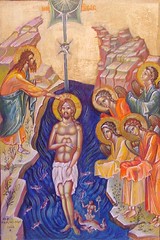
The icon of the Baptism of Christ is indicative of this cosmic dimension of Christ's baptism. If you look at the bottom third of the icon you will see two figures a bearded man and a dragon. In the top icon the man has wings in the bottom icon the man sits on the back of the dragon. The man symbolizes/represents the spirit of the Jordan, the dragon is the great leviathan representing the ancient chaos/waters overwhich the Spirit hovered at creation. The action is one of both being repelled and brought back under the rule of their creator. In the top icon we have the more ancient form of the icon with Christ's hand in the water in blessing. The Icon shows also the tension we still live in Christ has come the work of the bringing of all things back into right relationship with God has been accomplished and is being accomplished, we pass through water in identification with Christ: dying and being brought back to new life in the waters of baptism. Water remains both in service to life and death.
Jesus baptism, our baptism, has cosmic significance. Water, that potentially destructive force is that which we pass through to new life, that in which we are identified with Christ.
Since it is customary in some Covenant chruch's to remember one's baptism and renew the vows of baptism, I place on the table a bowl of holy water, and invited any who wished to come forward and dip their hand in the water and make the sign of the cross (the sign of the trinity Father Son and Holy Spirit)in remeberance/renewal of their baptism.
Thursday, January 6
Weekly update: Epiphany
Weekly update: Epiphany

When Thou, O Lord, wast baptized in the Jordan the worship of the Trinity was made manifest! For the voice of the Father bare witness to Thee, calling Thee his Beloved Son. And the Spirit, in the form of a dove, confirmed the truthfulness of his Word. O Christ our God, who hast revealed Thyself and hast enlightened the world, glory to Thee (Troparion).
Today Thou hast appeared to the universe, and Thy Light, O Lord, has shone on us, who with understanding praise Thee: Thou hast come and revealed Thyself, O Light Unapproachable! (Kontakion).
O God, by the leading of a star you manifested your only Son to the Peoples of the earth: Lead us, who know you now by faith, to your presence, where we may see your glory face to face; through Jesus Christ our Lord, who lives and reigns with you and the Holy Spirit, one God, now and for ever. Amen. (BCP)
When Thou, O Lord, wast baptized in the Jordan the worship of the Trinity was made manifest! For the voice of the Father bare witness to Thee, calling Thee his Beloved Son. And the Spirit, in the form of a dove, confirmed the truthfulness of his Word. O Christ our God, who hast revealed Thyself and hast enlightened the world, glory to Thee (Troparion).
Today Thou hast appeared to the universe, and Thy Light, O Lord, has shone on us, who with understanding praise Thee: Thou hast come and revealed Thyself, O Light Unapproachable! (Kontakion).
O God, by the leading of a star you manifested your only Son to the Peoples of the earth: Lead us, who know you now by faith, to your presence, where we may see your glory face to face; through Jesus Christ our Lord, who lives and reigns with you and the Holy Spirit, one God, now and for ever. Amen. (BCP)
The Journey of the Magi and the Baptism of Jesus, images brought together in Epiphany. God reveals himself to to the world in the human Jesus. The Eastern Church and the Western Church chose to emphasize different aspects of what was originaly all celebrated on Epiphany, including the Nativity. We now separate out the Nativity(Christmas) and the coming of the Magi (Epiphany) and the Baptism of the Lord (First Sunday after Epiphany).
And so we have moved from waiting for Christ's coming into walking into the reality of God's presence with us in Christ, the Church, Christ's Body, and in the Eucharist. We come like the Magi seeking God with us.
This is our journey at Reconciler, seeking Christ who has found us and incorporated us into one Body through baptism and faith.
There are several things ahead of us. We are still in the process of writing our constitution. We will have our next congregational constitution meeting after worship on Sunday January 13th. Upon the recomendation of Jolene Bergstrom Carlson, Associate Superintedent of ECC Central Conference, we will not be seeking reception by the Covenant this year, so we have more time to iron out some of the challenges of institutionaly bringing three different denominations together in one congregation. However, we still need to have a proposed constitution that we can present to the relavent bodies and for our own day to day functioning as a church
Lastly we want to encourage you to continue inviting your friends and sharing Reconciler with people you meet.
 We Three Kings
We three kings of Orient are;
Bearing gifts we traverse afar,
Field and fountain, moor and mountain,
Following yonder star.
O star of wonder, star of light,
Star with royal beauty bright,
Westward leading, still proceeding,
Guide us to thy perfect light.
Born a King on Bethlehem’s plain
Gold I bring to crown Him again,
King forever, ceasing never,
Over us all to reign.
Frankincense to offer have I;
Incense owns a Deity nigh;
Prayer and praising, voices raising,
Worshipping God on high.
Myrrh is mine, its bitter perfume
Breathes a life of gathering gloom;
Sorrowing, sighing, bleeding, dying,
Sealed in the stone cold tomb.
Glorious now behold Him arise;
King and God and sacrifice;
Alleluia, Alleluia,
Sounds through the earth and skies.
O star of wonder, star of light,
Star with royal beauty bright,
Westward leading, still proceeding,
Guide us to thy perfect light.
The peace of God, Father Son and Holy Spirit, be with you this Epiphany, and every day.
the Pastoral Team
Sunday, January 2
sermon
Second Sunday of Christmas - January 2, 2005
Jeremiah 31:7-14 or Sirach 24:1-12
Psalm 147:12-20 or Wisdom of Solomon 10:15-21
Ephesians 1:3-14
John 1:(1-9), 10-18
I minister before him.
Before God, I tell my story. Before God, I sing my song. With harp, voice, word, sacrament, icon, hymn, chant…in darkness and in light, in sorrow and in joy it is before God that I set forth worship, where my work is done. There I bring forth my produce, my offering to God of my labor and myself. Taste and see that the Lord is good, that the LORD, the Great I Am, is God.
And I am with him.
When I was in college, I had the wonderful fortune of taking a class in Wisdom literature. For those of you who are unfamiliar with the genre, Wisdom literature is a strain of Hebrew canonical and extracanonical writing. Proverbs, some Psalms, Ecclesiastes, Ecclesiasticus, the Wisdom of Solomon are all examples of the tradition. In it, Wisdom is personified. Wisdom is usually female. Wisdom is with God in the beginning of all things. God created her and through her, God created.
In our readings for today, we are presented with a good sample of the Wisdom tradition including the prologue to John. “In the beginning was the Word”…God’s breath made active, real, incarnate. Many scholars include this prologue in the Wisdom literature genre. It is mystical and yet, as wisdom, practical.
As I began to understand this tradition through my studies, all manner of things became clear. This was where the incarnation finally began to make sense to me. I do not know why hearing about Jesus, the man, Emmanuel, never had the same impact, but that is the truth of it. I guess I was in need of Wisdom.
There she was, standing before me, worshiping God, calling out, creating, praising and even warning her beloved creation. Wisdom called me to repentance…to bear the truth of God present and not absent. That fateful day when we read the prologue to John’s gospel in class, when the Word came down, then I saw. Then I saw God before me. Then I had a glimmer of understanding about Jesus. Then the pieces slowly, painfully began to come together.
It was as if I was remembering something long forgotten, like remembering a promise, or perhaps, a memory of food. Certainly, it was like a memory of being fed. Do you know what I mean? The smells and tastes come together. It is as if I could step back in time and experience it all for the first time all over again. It was a food memory. I have food memories.
One of my favorites is from Brasserie Jo’s on Hubbard Street. They have chocolate mousse that is beyond compare. I remember the first time I went there and ordered the mousse for dessert. The waiter wheeled out a cart. On the cart was a white soup tureen. From that tureen, he served the mousse spoon after spoonful on our plates. Then came the vanilla cream sauce and the chocolate shavings. Amazing.
I went there years ago. Occasionally I have the cravings, the memory comes back to me. I can smell the restaurant. I can taste the mousse. Praise God, Trish and I had the opportunity this Christmas to go to Brasserie Jo’s for dinner. The hospital gave its employees gift certificates this year and I talked Trish into going. I had not been in years.
The food was great. At least mine was. The mushroom soup was rich and thick. I could have stopped there. But I did not. The seafood-filled pastry shell I had as an entrée was outstanding. It came on a bed of rice with blanched spinach leaves; salmon, swordfish, scallops and shrimp with caramelized onions and leeks in a lobster cream sauce. The French love their sauces.
And as if that was not enough…
…then it was time for dessert. You know how this must turn out, don’t you? Mousse. It was just as I recalled it. Out came the tureen. The server had a large spoon. He only had to dip it in twice.
Scoop. Scoop.
There it was: chocolate mousse. The cream came next, thick and sweet followed by the shavings of chocolate. It was everything I remembered. It was perhaps even better than I remembered. It simply melted in my mouth. With the coffee, it was perfect. The combination of tastes had me in a stupor. How I love food. How I love to eat…to taste, to savor. It is a great joy.
This is whom she brings to worship, to her rest in Jerusalem. She brings herself.
Okay Larry, this is for you.
Roland Murphy, who was professor at Duke Divinty School, reminded me that the Greek in this passage for ministered is “eleitourgesa.” Liturgy. This is liturgical worship, he says. Wisdom is established in the Temple in Jerusalem. This is where Wisdom rests on earth, in worship…in our liturgy, in the work of the people manifested in the City of God. This is enough food for thought for our little church to last us for a good long while, is it not?
But this is still a memory. This is a food memory, it is so close, so true and yet I still miss it. I may catch it at a glance. But, it is only in the rare moments that all the pieces come together that I can gather them all. And even those are mere moments. Fleeting.
God must come to us. Our will is for our choice.
It is Christmas…yes, still Christmas. God is here with us. God has come to us. We can choose Wisdom. She stands before us.
The Christ child is present. The Word is made flesh. Wisdom lies in a manger. In the flesh of the Son of God, Wisdom will heal us, teach us, preach to us, pray for us and even dine with us. Wisdom is loose in the world as in the beginning.
It is Christmas.
The promise is fulfilled. Wisdom is here.
Taste. See. Tell your story. Sing your song. Give life to memory.
Amen.
Jeremiah 31:7-14 or Sirach 24:1-12
Psalm 147:12-20 or Wisdom of Solomon 10:15-21
Ephesians 1:3-14
John 1:(1-9), 10-18
24:10 In the holy tent I ministered before him, and so I was established in Zion.
24:11 Thus in the beloved city he gave me a resting place, and in Jerusalem was my domain.
I minister before him.
Before God, I tell my story. Before God, I sing my song. With harp, voice, word, sacrament, icon, hymn, chant…in darkness and in light, in sorrow and in joy it is before God that I set forth worship, where my work is done. There I bring forth my produce, my offering to God of my labor and myself. Taste and see that the Lord is good, that the LORD, the Great I Am, is God.
And I am with him.
When I was in college, I had the wonderful fortune of taking a class in Wisdom literature. For those of you who are unfamiliar with the genre, Wisdom literature is a strain of Hebrew canonical and extracanonical writing. Proverbs, some Psalms, Ecclesiastes, Ecclesiasticus, the Wisdom of Solomon are all examples of the tradition. In it, Wisdom is personified. Wisdom is usually female. Wisdom is with God in the beginning of all things. God created her and through her, God created.
In our readings for today, we are presented with a good sample of the Wisdom tradition including the prologue to John. “In the beginning was the Word”…God’s breath made active, real, incarnate. Many scholars include this prologue in the Wisdom literature genre. It is mystical and yet, as wisdom, practical.
As I began to understand this tradition through my studies, all manner of things became clear. This was where the incarnation finally began to make sense to me. I do not know why hearing about Jesus, the man, Emmanuel, never had the same impact, but that is the truth of it. I guess I was in need of Wisdom.
There she was, standing before me, worshiping God, calling out, creating, praising and even warning her beloved creation. Wisdom called me to repentance…to bear the truth of God present and not absent. That fateful day when we read the prologue to John’s gospel in class, when the Word came down, then I saw. Then I saw God before me. Then I had a glimmer of understanding about Jesus. Then the pieces slowly, painfully began to come together.
It was as if I was remembering something long forgotten, like remembering a promise, or perhaps, a memory of food. Certainly, it was like a memory of being fed. Do you know what I mean? The smells and tastes come together. It is as if I could step back in time and experience it all for the first time all over again. It was a food memory. I have food memories.
One of my favorites is from Brasserie Jo’s on Hubbard Street. They have chocolate mousse that is beyond compare. I remember the first time I went there and ordered the mousse for dessert. The waiter wheeled out a cart. On the cart was a white soup tureen. From that tureen, he served the mousse spoon after spoonful on our plates. Then came the vanilla cream sauce and the chocolate shavings. Amazing.
I went there years ago. Occasionally I have the cravings, the memory comes back to me. I can smell the restaurant. I can taste the mousse. Praise God, Trish and I had the opportunity this Christmas to go to Brasserie Jo’s for dinner. The hospital gave its employees gift certificates this year and I talked Trish into going. I had not been in years.
The food was great. At least mine was. The mushroom soup was rich and thick. I could have stopped there. But I did not. The seafood-filled pastry shell I had as an entrée was outstanding. It came on a bed of rice with blanched spinach leaves; salmon, swordfish, scallops and shrimp with caramelized onions and leeks in a lobster cream sauce. The French love their sauces.
And as if that was not enough…
…then it was time for dessert. You know how this must turn out, don’t you? Mousse. It was just as I recalled it. Out came the tureen. The server had a large spoon. He only had to dip it in twice.
Scoop. Scoop.
There it was: chocolate mousse. The cream came next, thick and sweet followed by the shavings of chocolate. It was everything I remembered. It was perhaps even better than I remembered. It simply melted in my mouth. With the coffee, it was perfect. The combination of tastes had me in a stupor. How I love food. How I love to eat…to taste, to savor. It is a great joy.
19 “Come to me, you who desire me,Maybe my food memories are a gift. In Sirach we find Wisdom with this list, a sense-ational list of fragrances and tastes. She is beautiful to behold. She is seen. She is heard. You can smell her and taste her. She is no mere thought, no mere idea. She is Wisdom, herself both created and creator.
and eat your fill of my fruits.
20For the memory of me is sweeter than honey, and the possession of me sweeter than the honeycomb.
21Those who eat of me will hunger for more,
and those who drink of me will thirst for more.
This is whom she brings to worship, to her rest in Jerusalem. She brings herself.
23 All this is the book of the covenant of the Most High God, the law that Moses commanded us as an inheritance for the congregations of Jacob.She is all Law, all Wisdom. This is who ministers before God. This is whose liturgy is established.
Okay Larry, this is for you.
24:10 In the holy tent I ministered before him, and so I was established in Zion.
Roland Murphy, who was professor at Duke Divinty School, reminded me that the Greek in this passage for ministered is “eleitourgesa.” Liturgy. This is liturgical worship, he says. Wisdom is established in the Temple in Jerusalem. This is where Wisdom rests on earth, in worship…in our liturgy, in the work of the people manifested in the City of God. This is enough food for thought for our little church to last us for a good long while, is it not?
But this is still a memory. This is a food memory, it is so close, so true and yet I still miss it. I may catch it at a glance. But, it is only in the rare moments that all the pieces come together that I can gather them all. And even those are mere moments. Fleeting.
22Whoever obeys me will not be put to shame,I do not always obey. I do not always work with Wisdom. No matter how hard I try, I fall short. I know that I read too much Calvin for some, but I do firmly believe that he is right when he says that there is nothing we can do on our own to fulfill this injunction. No matter our thirst or hunger, our will is not enough.
and those who work with me will not sin.’
God must come to us. Our will is for our choice.
It is Christmas…yes, still Christmas. God is here with us. God has come to us. We can choose Wisdom. She stands before us.
The Christ child is present. The Word is made flesh. Wisdom lies in a manger. In the flesh of the Son of God, Wisdom will heal us, teach us, preach to us, pray for us and even dine with us. Wisdom is loose in the world as in the beginning.
3‘I came forth from the mouth of the Most High,Our little church sits in the midst of the world…in a stall of our own. We all have our memories, a promise kept safe. We can taste hope. There is sweetness like honey. We hunger for God made flesh in our midst.
and covered the earth like a mist.
4I dwelt in the highest heavens,
and my throne was in a pillar of cloud.
5Alone I compassed the vault of heaven
and traversed the depths of the abyss.
6Over waves of the sea, over all the earth,
and over every people and nation I have held sway.
It is Christmas.
The promise is fulfilled. Wisdom is here.
Taste. See. Tell your story. Sing your song. Give life to memory.
Amen.
Subscribe to:
Posts (Atom)