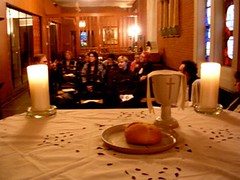
Wednesday, May 31

Almost Weekly Update

In the last days it will be, God declares, that I will pour out my Spirit upon all flesh, and your sons and your daughters shall prophesy, and your young men shall see visions, and your old men shall dream dreams. - Acts 2:17


Our brother, St. Peter, spoke these words from the prophet Joel to those who witnessed Christ's followers speaking in tongues. What seems to be drunkenness is not. What appears foolish is not. Peter interprets events and scripture to bring the truth to light. Interpretation is one facet of the communication that takes place within the community of gathered faithful. In this, Peter is following Christ's example:


Then he said to them, "These are my words that I spoke to you while I was still with you--that everything written about me in the law of Moses, the prophets, and the psalms must be fulfilled."

Then he opened their minds to understand the scriptures - Luke 24:44-45

Interpretation is the act of a community. It is the dialog between those of us who gather as Christ's body...a conversation with one another and with God who is the living Word. As week study and learn, preach and sing, praise and pray, give and work we interpret God's word. In this way we are always interpreting scripture. In this way we are like Christ, a living Word.


Announcements:


We will not be meeting at North Shore Baptist Church for Bible study this week. Instead we will be gathering at the Fourth Presbyterian Church for a special event. Old Testament scholar Walter Brueggemann, a widely sought-after preacher, teacher, and lecturer, has been invited to be the Theologian in Residence at Fourth Presbyterian.


Wednesday, May 31, 2006
7:30 p.m., on “Ancient Prophets of Israel as Contemporary Voices of Faith”

126 E. Chestnut St. in Chicago

(Michigan Ave. and Chestnut St.)


Larry Kampohausen, our Covenant pastor, will be giving an iconography workshop.

Saturday, July 15 at 10:00am

Sliding Scale fee: $15-$10 suggested per class (no one will be turned away)
Classes hosted by Wicker Park Grace @ Acme Art Works
1741 N Western Ave in Chicago

Please register in advance to nsawyer /at/ wickerparkgrace.net, or by calling 312-399-2081.

Tuesday, May 30

Sermon: Feast of the Ascension of Our Lord (observed)

Sermon: Feast of the Ascension of Our Lord

Church of Jesus Christ, Reconciler

May 28, 2006


Acts 1:1-11

Psalm 47

Ephesians 1:15-23

Luke 24:44-53


Monday is Memorial Day and, per our usual for the past few years, Trish and I have been house-sitting this weekend for some friends of ours.  They have a dog and go out of town over the holiday weekend.  The dog, Texas, needs walking and company.  So, Trish and I hang out at our friends place, walk the dog, eat their food, enjoy the comfort of their home and most importantly, watch cable television.  We watch lots of television.  Trish and I never bothered to get cable.  Thus it is a treat for me.  Spending time surfing through 70 channels always gives me pleasure.


One of the things that always surprises me, however, when we stay over Memorial Day weekend is the number of films on cable TV about war.  I skipped over everything from The Red Badge of Courage to Bridge over the River Kwai.  Some channels commit their weekend programming to films about the wars our country has experienced.  Some are critical.  Some are romantic.  Some are patriotic.  Some are a combination of all three and more.  In any case, the networks strive to remember our war dead.  This is a weekend for memory. 


One film in particular caught my attention Ike: Countdown to D-Day.    It was about General Eisenhower and the days leading up to the invasion of NormandyD-Day.  It stars Tom Selleck and depicts the personal struggles that Ike experienced in those days.  It is based off of letters he wrote and other wartime journals.  It is not a very good film and I am no fan of war, but I could not help myself but to be moved.


I know some of you have seen  this before.  This is my great-uncles pith helmet.  He trained men for the Pacific theater in WWII.  He was the oldest of three brothers.  My grandfather was the middle son.  He, too, fought in WWII with the Third Infantry Division.  The youngest of the three actually participated in the invasion at Normandy. 


The constant barrage of films on the television reminds me of these three men.  The three have since passed on.  But I remember them.  Every year we are told that such memory is a virtue.  Each year we extol the great deeds and the larger-than-life personalities of Generals and heroes.  Each year we make a ritual of memory.  We acknowledge the contributions of those who have gone before us.  Well, this is at least the purpose of the holidayeven if many of us take trips to the beach.  In any case, we honor a memory.  We memorialize. 


Many suggest that there is no greater honor than to remember someone.  Immortality, it is said, can be achieved through the memory of others.  This was the desire of many in the ancient world.  If your deeds are great, you will be remembered.  Thus, you will not die.  Mortality (Immortality?) and memory are linked for many of us.


So today we are presented with Lukes Gospel.  In both the Gospel proper and in Acts, Luke shares with us his recollections of Christ.  He speaks of proofs and interpretation.  He speaks of prophetic words brought to fruition.  He shares one memory in particular.  He reminds us of the Ascension of Christ.


Acts 1:9 When he had said this, as they were watching, he was lifted up, and a cloud took him out of their sight.


Luke 24:51 While he was blessing them, he withdrew from them and was carried up into heaven.


This is our observation of the Feast Day of the Ascension of Our Lord.  This is the day in the church year where we remember the fulfillment of scripture, the call to mission and Christs ascension into heaven to be with God.  This is no small feast.  This is no small celebration.  But it is often a forgotten one.  Most of the churches I have been affiliated with simply gloss over it.  There are reasons for this.  Technically, the feast is


the fortieth day after Easter SundayIn the Eastern Church this feast was known as analepsis, the taking up, and also as the episozomene, the salvation, denoting that by ascending into His glory Christ completed the work of our redemption. The terms used in the West, ascensio and, occasionally, ascensa, signify that Christ was raised up by His own powers. Tradition designates Mount Olivet near Bethany as the place where Christ left the earth.

The feast falls on Thursday. It is one of the Ecumenical feasts ranking with the feasts of the Passion, of Easter and of Pentecost among the most solemn in the calendarSt. Augustine says that it is of Apostolic origin, and he speaks of it in a way that shows it was the universal observance of the Church long before his time. Frequent mention of it is made in the writings of [Church Fathers]

Certain customs were connected with the liturgy of this feast, such as the blessing of beans and grapes after the Commemoration of the Dead in the Canon of the Mass, the blessing of first fruits, [and others]In the liturgies generally the day is meant to celebrate the completion of the work of our salvation, the pledge of our glorification with Christ, and His entry into heaven with our human nature glorified[i].


Since it is on a Thursday, many believers cannot honor the feast.  We are at work.  Its really very simple.  And though it is a step away from honoring the specific Western church calendar, we here at Reconciler thought we would move it to Sunday.  The completion of our salvation, as the good people at New Advent state, is something worth remembering.


I know that I may be beating a drum a bit here, but this is one more Feast Day that I wish us Baptists paid attention to.  I know that not everyone here is a Baptist, but I hope the rest of you will be patient with me. 

It is not that we dont talk about the Ascension of Christ.  It is not that we dont know it is there, but somehow the salvific nature of Christs ascending to be with God has been lost for me.  Maybe I am the only one and I need to go back to Bible school.  Perhaps.  But I am somehow always caught by surprise by these verses.  When I think of Jesus and the post-resurrection stories, I forget that Jesus ascends to heavennot that he has ascended, but that he ascends.  I know he is there.  I just forget that he had to get there.  It is only an event from the past for meand not a memorable one at that.


I have read Calvin and all of the Reformation arguments about how Jesus cannot be in the bread and wine of communion because he is too busy sitting at the right hand of God.  After all, how can Jesus be in two places at once?  The theological arguments aside, I always forget how Jesus gets to Gods side in the first place.  I only know that he is there.


Now I wonder if that memory lapse is important.

Now I wonder if I have forgotten something that I should not have.

What difference does it make that he ascends?


Maybe none.  Maybe he could have taken a cab and it would have been just as effective.  However he gets to Gods side is fine as long as he gets to Gods side.  Right?


But no.  Luke reminds usproofs.  It is about fulfillment of prophesy and scripture.  It is all of a piece.  This brief passage from Luke is of a single piece.  By ascending, once again Jesus fulfills prophesy.


Lukes Gospel begins and ends with the Temple.  Prophesy, prayer and praise go hand in hand in hand.  We begin the Gospel with Zachariah in the Temple proclaiming the birth of a Messiah.  We end with the followers of Christ continually in the Temple blessing God.[ii]  Between these two events there is interpretation and healing.  The needs of the poorest are met.  People are fed.  Scripture is fulfilled.  Jesus reminds his disciples of this just before he ascends (there is that memory thing again).  Lets look at Luke again.


Thus it is written, that the Messiah is to suffer and to rise from the dead on the third day[iii]


These things are from memory.  These events are from of old.  This is not new.  This is not news.  This is the very thing that has been proclaimed.  It has always been thus


But Jesus does not stop there. 


and that repentance and forgiveness of sins is to be proclaimed in his name to all nations, beginning from Jerusalem.[iv]


These things are a whole.  The fulfillment of scripture in Jesus and the proclamation of the Gospel to all nations, throughout the world are of a single, inseparable piece.  But why?  What makes for the connection?


Memory.


You are witnesses to these things.


We are witnesses to what has always been remembered. 

Jesus asks the disciples to remember.

He asks us to remember.


We are witnesses to what has come to pass in our midst.  What Luke wants us to know is that this is more than mere memory.


The reason why I am troubled by my forgetfulness, my inability to recall how Jesus got to heaven in the first place, is that I am missing the very thing that is happening before my very eyes.  This event is ongoing, eternal.  The Ascension is now.  The Ascension is always.  The fulfillment of scripture is happening before me every moment of every day.


Memory is not always simple recollection for the Christian.  We do not get a photo album of Jesus and his good works.  We get prophesy fulfilled.  We have before us open doors into heaven itself.  The true prophesy is a window into the will of God.  A prophesy fulfilled is the very presence of God with us. 


And it is this that I fear I forget when I forget that Jesus ascends.


I forget the blessing that is the Ascension.  I forget the blessing that is the fulfillment of prophesy.  I forget the blessing of Jesus himself as he extends his hands to his beloved.  I forget God extending Gods own hands to me.


Maybe I lump too much together.  But then there are Pauls words to the church in Ephesus. 


God put his power to work in Christ when he raised him from the dead and seated him at his right hand in the heavenly places


And it is this power that is revealed in the church in Ephesus.  Why?  Because for some reason, whether it is publicity or earned reputation, the Ephesians apparently get it.  They know that they are the Body of Christ who sits


far above all rule and authority, power and dominion, and above every name that is named, not only in this age but in the age to come.


It is not that the Church can ignore the law of the land, but that the Church understands that its very nature extends beyond all boundaries. Salvation exists for all.  This is the promise and proclamation of God.  This is Jesus charge to usthe last thing he says to us in Lukes Gospel.


You are witnesses to these things.

We are witnesses to the things that extend beyond what we simply recollect.

We are witnesses to the things that are beyond mere memory.

What we remember is the God Who Isthe salvation that is present and activegenerously holding out his hands to us granting us his blessing.


This is what we witness every daythis memory being fulfilled before our very eyes.


[ii] NRSV Luke 24:53

[iii] NRSV Luke 24:46

[iv] NRSV Luke 24:47

Monday, May 15

Sermon Fifth Sunday of Easter

Acts 8:26-40
Psalm 22:25-31
1 John 4:7-21
John 15:1-8

“I am the true vine…” Jesus tells us, “Abide in me as I abide in you…. I am the vine you are the branches….” In this extended metaphor and parable we are given an image of the church as a community of persons who are one with Christ. This image of the vine is related to the Old Testament image of the vineyard: the vineyard is Israel and the Landowner /vinedresser is God. Elsewhere in the Gospels Jesus uses the image of the vineyard in some of his critiques of his opponents who claim to be the religious leaders of Israel. Jesus in our Gospel today narrows the focus of the metaphor to articulate the relationship between himself and the People of God. The people of god is reconceived as centered on and constituted by Jesus Christ. This is so because Jesus is the word of God in human flesh, the very wisdom of God. All this though explains the background and the origin of the image Jesus is using but does not begin to touch on what it means to abide in Christ or bear fruit. The actions of Philip and the reflection on love in 1 John can help open up the meaning of the vine and branches. As we explore these passages we find that abiding in Jesus Christ is recognizing the source of our life is god and that bearing fruit is openness to life that is beyond our own life. Taken together this is the life of the church, the life of the Spirit.

In Acts Philip is one of many examples of a life lived by the power of the Spirit. Philip is abiding in Christ and bearing fruit. We see this more fully when we look at the whole story of Philip as presented in Acts. Philip is one of the deacons of the church chosen when controversy over the care of widows erupted in the early church. Shortly after this the deacon Stephen is martyred as the first persecution of the church begins. Because of this persecution in Jerusalem many of the early Christians disperse. Philip goes to Samaria and begins to preach the Gospel there. People respond and they are baptized. Peter and John come to check on this expansion of the church and find that the Spirit had not yet descended on the Samaritans yet and they lay hands on those baptized to receive the Holy Spirit.

Our lectionary text this evening follows upon those events. As we read Philip without asking for an explanation follows the directions of an “angel of the Lord” and heads down a certain highway. Along this road he happens upon the Ethiopian Eunuch and is directed by the Spirit and hears the Eunuch reading from the prophet Isaiah. It is important to note here that according to the law Eunuchs could be part of the people of God and were forbidden to enter the Temple. From this perspective the Ethiopian Eunuch was on the margins of the people of God both because he was a gentile and because he was a Eunuch. But Philip like he was in Samaria was open to the direction of God, and shares the Gospel of Jesus Christ with the Eunuch who then after hearing embraces the new life offered in the gospel and is baptized.

Philip in these stories is open to the flow of life that has it source in God. Like the branch of a vine which receiver its sap, its life, from the vine and passes that life on to the fruit, so Philip is open the Spirit knowing the source of his life and know that life is given to him for those beyond himself, even beyond the old boundaries. This was both his special calling as a deacon and simply what it meant to abide in Christ. Because of this openness life is brought to one who use to be kept beyond the people of God and who physically can not help bring new life into the world but who now baptized and in Christ can bring Christ the life of the world to Ethiopia. The fruitfulness of Philip is being open to the witness the truth of the Gospel in unlikely and unpredictable ways. Philips life is an example of the life and love of God flowing through the church giving life to the world. This is abiding in Christ so that there is fruit.

In 1 John abiding in Christ is explicitly spoken of as love. The logic of this passage is the same as the relationship between vine branch and fruit. John begins with identity: to know the God who is love means exhibiting that love oneself. This is so not simply because we are to give to others what we ourselves have received, but because we are joined to the source of love. We know this love not because we have found it in ourselves but because God has shown us love in Jesus Christ. Thus if we are truly abiding in God, God’s life is shown in us by our love for others. Living in Christ is to have that life which is between God and others. We receive from God love, and the love we receive is then directed towards others: ore sisters and brothers. This is fruitfulness.

Fruitfulness is the result of abiding in Christ as our life is lived in love from God and flows through us towards others. The life of the Church, and the life of all of us as members of Christ, comes from God and is for the sake and life and love. Like a fruit bearing brand we receive what we need for ourselves from Jesus Christ, the love of god. Yet this love, which sustains us, is to flow through us bring the life and love of God to others. Like a branch that bears fruit we lose nothing of what we need for our own life by passing on life to the fruit. We loose none of the love we receive from God by allowing God’s love to flow freely through us to the world.

This is the good news for us as members of Christ: apart from Christ we can do nothing! This is good news because the call to love brothers and sisters, neighbors, enemies is not meant by god to be done on our own efforts. The calling of he Church and of each of us as members (branches) of Christ is possible only as we allow ourselves to be fully embraced by the love of god: learning that God cares for us like a vinedresser cares for a vine and its branches, like a mother suckles her infant at her breast. Only as we abide in Christ and God’s love can we find the eternal flow of love and see God’s love and life flow through us to the world. This is so simple and yet so difficult. So often we hear and read these words as demand and expectation. We forget that these words are God’s loving appeal for us to rest in God so that we will never wither and loose our life but rather always have enough life and love for ourselves and the entire world.

Friday, May 12

Almost Weekly Update

From you comes my praise in the great congregation; my vows I will pay before those who fear him.
The poor shall eat and be satisfied; those who seek him shall praise the LORD. May your hearts live forever!
(Psalm 22:25-26)
Here is a quick rundown of what is happening at Reconciler these days...Fasten your seatbelts.

The Rev. Dr. Larry Greenfield, the Executive Minister of the ABC/Metro-Chicago Region, preached last Sunday. His sermon was entitled "Other Sheep." We will try to get a manuscript for you. His presence among us is a welcome and encouraging sign of our growing relationship with the American Baptist Churches.

Jane Schmoetzer has accepted a call to a ministry in Montana and will be leaving us. June 11 will be her last Sunday at Reconciler. Please join us that evening as we worship and celebrate together. We have been blessed by her ministry with us.

Thus...We have begun a search process for an Episcopal priest. This is happening with the help of the Ecumenical Officer of the Diocese. As it stands we do have a couple of interested parties. We will keep you all informed as this process continues. If you have any questions or suggestions, do not hesitate to ask one of the pastoral team or Katya, our Council President.

In related news, I have accepted a call to serve as Senior Pastor at Community Church of Wilmette in Wilmette, IL. They are only 20 minutes up Ridge Rd. from Reconciler, so I will be able to continue my ministry with you. Trish and I are thrilled about this opportunity. It bodes well for us personally and potentially for the continuing growth of Reconciler. Plus, now you all have a "country retreat" to visit from time to time. My first Sunday at CCW will be June 4.

Larry Kamphausen will be giving a workshop on icon writing with Wicker Park Grace. Nanette Sawyer is the pastor of that congregation and has been very supportive of our work at Reconciler. Stay tuned for the details.

Our Lord says that those who seek shall find, that those who seek will have reason to praise. Even during times of trial, our praise of God can serve to uphold us. Seek God this day. Praise the Lord!

Yours in Christ's Love,

Tripp Hudgins
The Pastoral Team