When we arrived at Chase Cafe last night for our evening service and Larry's installation, we found a copy of an article on the door reporting that Chase Cafe was to vacate the premises by court order by May 10th. We need to find a new space to meet. This does not come completely as a surprise we know that the landlord and Chase have been at it for some time and that the Landlord wanted them out. We were hoping, of course, that things could be worked out between the landlord and chase.
Please keep this in your prayers. We will keep you updated as we know where we are going. If we find no other place immediately there is a small chapel space at the Community of the Holy Trinity, but we can fill that up fairly quickly. That chapel space would not be a permanent solution.
Monday, April 25


Sunday, April 24
Fifth Sunday in Easter
Acts 7:55-60
Psalm 31:1-5, 15-16
1 Peter 2:2-10
John 14:1-14
Philip said to Jesus, "Lord, show us the Father, and we will be satisfied." Don’t you love the apostles? No wonder Jesus is exasperated! At this point, he’s been with them for three years. In all the time they’ve been living together, they’ve had plenty of opportunities to see Jesus at work, teaching and healing. In addition, I have to believe that over and above all the things we read in the Gospels, they’d been party to myriad unrecorded conversations that were further moments for learning, and understanding.
Jesus’ efforts in this regard continue right up until the last minute. This conversation is part of John’s record of the Last Supper, so time is about up, and Jesus knows it. He’s trying to provide some last minute instructions, some comfort for them to cling to in the days ahead.
And still, here’s poor Philip. “Show us the Father, and we will be satisfied,” he says. Only one more answer, one more bit of solid evidence, one more definitive image, and he’ll be content.
Don’t we all do that? Thinking that if only we had that one more key item, or piece of information, we’d be better off. If we made just a little more money, if we had a little more education, one more fancy toy. . .
I can’t help but wonder if it’s simply something in our human nature, never to be quite satisfied. To be endowed by our Creator, as our constitution says, with the inalienable right to be in pursuit of happiness-- always looking past what we know (or think we know) seeking yet another answer. searching for ultimate truth.
There are two things I’ve often found to be true about this sort of seeking: first, that what seems to be the goal, the cornerstone, if you will, the ultimate point of satisfaction, is in fact neither of those things. That instead, it is more like a steppingstone, something that leads me to move onward, seeking yet something else.
Secondly, it strikes me that what we’re searching for is usually closer than we think. “Show us the father,” Philip says-- as he stands not only facing Jesus squarely, but among friends and fellow disciples, all created in the image and likeness of God, if only he had eyes to see.
Today is a special occasion, as we gather seeking in this place. We worship God together here, as we do every Sunday; we celebrate God’s gifts to us in the presence of Jesus, made known to us in the breaking of the bread. But we also celebrate God’s presence in the call he has placed on Larry’s life, to be a minister of the Gospel.
My brother, the charge and the challenge Philip puts forward is one, in a way, that you have committed yourself to spend the rest of your life answering. “Show us the Father,” the world says. Give us a reason to believe. Explain yourself, and your faith in Jesus, the Christ. Live your life every day in such a way that we can see the face of God in your soul.
No small responsibility that, and having come to know you, one I know you do not take lightly. But you also you are well aware that with the habits of prayer, and study, and Christian community that you cultivate, following this path becomes, if not easy, then possible. Keep them constant, my brother. Not only for your own spiritual health and well-being, but because that is the way you-- that we all-- become more aware of the presence of God nearby; that we’re less likely to overlook the work of Holy Spirit around us, every waking minute. You thereby become that steppingstone I mentioned earlier, providing a path and a direction, with the spiritual work and discipline to keep the direction true.
It is my prayer as you are commissioned this evening that, with God’s help, you will be strengthened in leadership, and in service. You have seen the Father, my friend and my brother; show us.
And may we, in turn, by God's grace, have eyes to see.
Psalm 31:1-5, 15-16
1 Peter 2:2-10
John 14:1-14
Philip said to Jesus, "Lord, show us the Father, and we will be satisfied." Don’t you love the apostles? No wonder Jesus is exasperated! At this point, he’s been with them for three years. In all the time they’ve been living together, they’ve had plenty of opportunities to see Jesus at work, teaching and healing. In addition, I have to believe that over and above all the things we read in the Gospels, they’d been party to myriad unrecorded conversations that were further moments for learning, and understanding.
Jesus’ efforts in this regard continue right up until the last minute. This conversation is part of John’s record of the Last Supper, so time is about up, and Jesus knows it. He’s trying to provide some last minute instructions, some comfort for them to cling to in the days ahead.
And still, here’s poor Philip. “Show us the Father, and we will be satisfied,” he says. Only one more answer, one more bit of solid evidence, one more definitive image, and he’ll be content.
Don’t we all do that? Thinking that if only we had that one more key item, or piece of information, we’d be better off. If we made just a little more money, if we had a little more education, one more fancy toy. . .
I can’t help but wonder if it’s simply something in our human nature, never to be quite satisfied. To be endowed by our Creator, as our constitution says, with the inalienable right to be in pursuit of happiness-- always looking past what we know (or think we know) seeking yet another answer. searching for ultimate truth.
There are two things I’ve often found to be true about this sort of seeking: first, that what seems to be the goal, the cornerstone, if you will, the ultimate point of satisfaction, is in fact neither of those things. That instead, it is more like a steppingstone, something that leads me to move onward, seeking yet something else.
Secondly, it strikes me that what we’re searching for is usually closer than we think. “Show us the father,” Philip says-- as he stands not only facing Jesus squarely, but among friends and fellow disciples, all created in the image and likeness of God, if only he had eyes to see.
Today is a special occasion, as we gather seeking in this place. We worship God together here, as we do every Sunday; we celebrate God’s gifts to us in the presence of Jesus, made known to us in the breaking of the bread. But we also celebrate God’s presence in the call he has placed on Larry’s life, to be a minister of the Gospel.
My brother, the charge and the challenge Philip puts forward is one, in a way, that you have committed yourself to spend the rest of your life answering. “Show us the Father,” the world says. Give us a reason to believe. Explain yourself, and your faith in Jesus, the Christ. Live your life every day in such a way that we can see the face of God in your soul.
No small responsibility that, and having come to know you, one I know you do not take lightly. But you also you are well aware that with the habits of prayer, and study, and Christian community that you cultivate, following this path becomes, if not easy, then possible. Keep them constant, my brother. Not only for your own spiritual health and well-being, but because that is the way you-- that we all-- become more aware of the presence of God nearby; that we’re less likely to overlook the work of Holy Spirit around us, every waking minute. You thereby become that steppingstone I mentioned earlier, providing a path and a direction, with the spiritual work and discipline to keep the direction true.
It is my prayer as you are commissioned this evening that, with God’s help, you will be strengthened in leadership, and in service. You have seen the Father, my friend and my brother; show us.
And may we, in turn, by God's grace, have eyes to see.
Monday, April 18
Sermon Fourth Sunday in Easter
Psalm 23
1 Peter 2:19-25
John 10:1-10
I wish to suggest that all or our texts direct us towards relationship as the basis of faith and church. The picture of this is a shepherd and flock. The working out of this reality of faith and church as relationship is found in the Acts account of the first church in Jerusalem, the newborn church, the Body of Christ. I wish to lead us to see the words about Jesus as shepherd as not only addressed to us as individual believers but as this particular local church, Church of Jesus Christ, Reconciler. Our gathering here is about relationship with Christ, with each other and of this church with the world. I hope that tonight we can begin to see ourselves as the flock of Christ,following his voice leading us forward together with each other, knowing we are each cared for free us as to care for each other.this sermon is as much for the pastoral team and me, as we struggle to work with you in this church.
The point of Jesus' parable of sheep and shepherd might be difficult for us to see given that if you are like me we havent been around sheep or shepherds much. ( but then our text says that Jesus audience didnt get at first either) Our images of flocks and sheep and shepherd are born out of idyllic pictures, or hearsay.
Shepherd and sheep dog in Ireland.
On vacation with some friends in the British Isles, we were in about our second week of traveling and had made our way to the west coast of Ireland. My friends and I had just left the B&B we had stayed the night before full of a good breakfast of eggs, blood sausage, tomatoes and toast. As we rounded a curve in the road we saw a shepherd leading his flock with a little sheep dog following behind to catch any stragglers. Except for the few stragglers that seemed to want to go off and eat the bit of clover in the opposite direction the shepherd was taking them, the sheep formed a tight group around the shepherd. The flock almost moved as a single organism with the shepherd at its head. It was an amazing and beautiful sight The flock and sheep dog moved with the shepherd, and the sheep dog kept the independent minded sheep from straying too far.
The tight formation and the ease of movement exemplify to me trust, relationship, care perhaps even love. The shepherd leads and the sheep (for the most part) follow, bunched together, there is relationship between the sheep. There is the relationship between the sheep dog and shepherd, a mutual trust a deep connection the dog simply follows the lead of the shepherd, and the sheep dog with the sheep. It would not work if the sheep did not trust the sheep dog. Part of what was so beautiful of seeing the shepherd his flock and the sheep dog was the level of trust and care exemplified in the movements.
In Jesus parrable the shepherd cares for the sheep and two the sheep know the shepherd. Its an image of relationship of trustand care, of safety and threat. Sheep know the difference between the one who cares for them and the one who intends them harm.
Christ is shepherd of our souls is our provision and our protection. Knowingthis protection our texts today speak of following our shepherd, yes through the valley of the shadow of death, through even persecution. We are to exhibit the trust of the sheep for the shepherd and follow, together
This is the image of the church, the flock of Christ, universal and local. It is a picture of who we are as a gathered community.
Acts community as sheep and shepherd.
What makes this possible is the trust imaged in Jesus parable. The care exemplified here is the first church embodying Christ, following the shepherd and being provision for the flock. I wish to be careful here for I dont want to lift up the Acts community in Jerusalem as perfect, nor simply abstract their actions and assume what is written should not be lived out. Two things I wish to draw out, first: the actions described can only be explained if there already existed an environment of trust and love. I doubt very seriously that people will voluntarily give up their possessions and give to a group to distribute as necessary it there is not only an environment of trust but of love of the other.
What I am seeing this evening is that it is the relationship that Christ has with the church of care and provision as shepherd of the flock, the church, that is the basis for what we find described in these early chapters of Acts.
The basis of the life of the church is the reality of the image of shepherd and flockl. It means that the church incarnates the provision of Christ the shepherd. In trusting in Christ: if we truly trust and love Jesus Christ as our shepherd as the one who cares loves protects and is our provision, then something of the attitudes that made possible the church in Jerusalem is available to us.
The point is this Christ is our shepherd, he cares and provides for the flock the Church. Second sheep follow in the way of the shepherd. They trust the shepherd. The community of the church is created by this common trust in Jesus Christ, The Son, who is raised from the dead.
Our existence as a community of faith is here in our trust in Christ, in our following in the way of Christ. And any community that bears the name of Christ and follows in his way will manifest Gods caring for us. Providing what any had need. We are to follow in the way of Christ to care for one another as Christ cares for us.
Do you know, do I know, do we know, what it is to have this relationship with Jesus Christ, with God, pictured in John 10? Do we trust in God as the psalmist does. Do we as individuals, do we as this local church, church of Jesus Christ Reconciler.
What we offer as an ecumenical church is grounded in the reality of this parable. We come together believing there is one shepherd and one flock. And so Our ecumenical effort has to be about relationship about living into the reality of faith and church exemplified in these texts. Faith and church are about relationship, first our relationship to Christ and because of that relationship to each other. From their we can be Christ to each other the church as the flock of Christ becomes that nexus of relationship love care and trust, that leaves people in awe, and allows people to hear the voice of Christ as the shepherd of theirs souls, and end their lost wandering.
We are here to be in relationship with God, with one anther and with the world, that all may be drawn to Christ and find that they and we no longer need to trust in our own efforts our own resources, but all comes from God, and in trust andlove we can find the generous abundant life, found only in Christ, which should also mean with the flock that follows the shepherd, the church.
Saturday, April 16
Update Addendum
We realized we forgot one announcement. Not only is Larry now licensed by the Evangelical Covenant Church, he will also be installed as the Covenant pastor at Reconciler on Sunday April 24, by the Associate Superintendant of the Central Conference, Jolene Bergstrom Carlson. The instalation will take place at our usual 6 PM weekly worship service. All are invited to attend this service and celebrate with us on this significant milestone in the life of Reconciler.
The Pastoral Team
The Pastoral Team
Present For A Bishop
Our own Jane Schmoetzer, now Reverend Jane Ellen Schmoetzer, is pictured here. She is the one on the right in the photo (at the left hand of the Bishop, that is).
Reconciler is fortunate to have her. And with Larry's licensing service/instalation set for the 24th, we are well up to full steam! Thanks be to God. Congratulations, all!
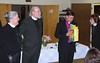
Reconciler is fortunate to have her. And with Larry's licensing service/instalation set for the 24th, we are well up to full steam! Thanks be to God. Congratulations, all!
Wednesday, April 13
Update
He is Risen indeed, Alleluia!
Jane and Tripp each have been encouraging us in their sermons to see God at work in the midst of the intangable and when things don't seem to quite add up. Resurection needs to make a difference, and yet how do we live into the reality of the Resurection? We are often like the disciples on the road to Emmaus, unable to recognize God, the Risen Christ with us on the Journey. May we truely encouter the Risen Christ this Easter season, and my we be converted.
We have much good news to share. Jane is back with us and she is to be ordained a Deacon this Friday, April 15th. Larry now has an interim ministers license from the Evangelical Covenant Church and goes for his first license interview on April 27th. Keep him and the interview in your prayers. Things continue to move ahead, even if slowly. But that seems to be the way of things for planting a church.
Tripp and Larry met last week with a colleague, Nannette Sawyer, who is planting a church in Wicker Park (visit the churh's web site). It was an encouragement to talk and compare and share experiences. We have differing approaches for a variety of reasons, one glaring reason is that it was a committee of the Chicago Presbytery that had the idea for the church plant and called her to be the church planter while we are still trying to get the institutional support we need.
Another thing that came from the meeting is how we might think of an intermediate space between interest in the church and actually coming to worship. The idea here seems to be how to find ways to allow church to be a safe place. Worship can be daunting to those who have never been or who are disenchanted with Christianity and church. They may be interested in coming back or in coming the first time but there is a need to create space where people can come that is not a worship service, and get to know people and the church.
I guess one could put it like this, coming to worship feels like committing to something or at least being fairly certain that church is safe. Knowing the person who invites you to a worship service is not enough to make it safe, the church itself needs to have a place where people can wade in the waters of Christianity. Some things to think about as we follow God's call as a church.
and he shall give you your heart's desire.
commit your way to the Lord and put your trust in him,
and he will bring it to pass.
He will make your righteousness as clear as the light
and your jsut dealing as the noonday.
Be still before the Lord
and wait patiently for him.
Psalm 37:4-7
The Pastoral Team
Monday, April 11
Alleluia! Something Happened! - A sermon for The Third Sunday of Easter
Acts 2:14a, 36-41
Psalm 116: 1-4, 12-19
1 Peter 1:17-23
Luke 24:13-35
I was in college when I started to wonder what all of the hubbub around Easter was all about. To some, this may seem a little late in the game to be asking such questions. I was a Junior in college. I was well into my religion major. I was participating in ministry efforts with the Baptist Student Union. I thought of myself as a Christian. I claimed the identity. Yet, I would deny Easter.
I simply did not believe that it made sense. I wanted it to make sense. There was one problem, but that’s another sermon. You have to understand that I was not some rationalist or even a skeptical empiricist. Christmas made sense to me; the Incarnation of God in a manger resonated with my soul in a way that Easter never did. The cross made sense. However, I could never buy into the Resurrection.
“So unnecessary!”
“Superfluous!”
“Cruel!”
I simply could not live with the possibility that Easter was integral to the faith. I would rail against it in my classes and with the few in the Baptist Student Union who would put up with me. I was sad and outraged. Somehow, all of my struggles as a young man were wrapped up in my denial of Easter.
One day, I brought all of my struggles to the college chaplain. In retrospect, I am sure that he heard nothing new from me. But, for me it was momentous. I was going to speak to the Reverend Doctor David Burhans, Southern Baptist pastor and university chaplain. I expected rejection and I was foolish to do so. Dr. Burhans had this resonant voice with a thick southern accent. He would speak slowly and carefully. The generous inflections that his accent brought seemed to deepen meaning in every word. And “generosity” is the only word that describes what he shared with me.
Today we find our friends, the two disciples walking along the Emmaus road. It is the third day. Their teacher and guide is dead. Their dreams have been destroyed; their hopes dashed. All they can do is walk. They are sad.
I have often wondered what they may have said to one another as they walked. Perhaps they spoke of nothing. Perhaps the mused about the lives that they would return to now that the ministry of Jesus had come to an end. I imagine that they grief and outrage weighed them down. I imagine that they might have been trapped in their heads trying to figure out what went wrong, what they could have done differently. Perhaps different words or sayings of Jesus’ echoed in their memories. “Stay with me.” “Remain with me.” “Tell no one.” “Go two by two.” “You have been made clean.” Grief has a way of taking over. Loss almost has a taste to it.
Then there appeared a stranger. The two spoke to him of Jesus and the strange stories about a resurrection. And they shared their disbelief. He rebuked them and spoke to them of prophesy and promises made and promises kept. Still, in their grief they were blind. Their eyes did not see.
As he seemed to move on ahead of them, the two begged him to stop and sup with them. “Stay with us,” they said.
vs. 29-31 So he went in to stay with them. When he was at table with them, he took bread, blessed and broke it, and gave it to them. Then their eyes were opened, and they recognized him; and he vanished from their sight.
Was it the interpretation? Yes…and no. Though their hearts burned, it was not until Christ revealed himself in action that he was recognized. Only in retrospect did they see him in the scriptures. But in intimacy, in a shared meal and a shared journey was he revealed.
All that he had ever asked of them that they could not do, to stay up and pray and eat and wait, he had done for them once again. In their grief and in their brokenness he stayed with them and fed them. This is how the risen Lord appears to the broken, the grieving, and the outraged.
Dr Burhans and I did not speak long. He listened as I shared my attitudes about Easter. I remember that when I finished speaking, I braced myself for the debate of a lifetime. He smiled, leaned across his desk and said,
“You know, Tripp, I could debate with you, but I doubt that would be of much help. But this is what I will say: Something happened on the third day. You have to sit with that. Challenging it is not doing you any good. You must learn to sit with it at the very least. Something happened.”
True enough. I sat there stunned. For me in that moment something did happen. Something was revealed. Something happened for the two followers of Christ. Jesus stayed. Jesus prayed. He broke bread. He returned from the dead and fulfilled the promises he made. Dr Burhans taught the lesson of the resurrection to me. It was not a question of being convinced of the evidence. It was not the issue of having just the right bibliographic citation, coursework, or training. No, I was not convinced. I have never been convinced.
I was converted.
Through the gentle urgings of Dr. Burhans, God walked with me. God stayed with me and I slowly began to listen to the story and my heart began to burn.
I love the LORD because he heard my voice and my supplications. Because he inclined his ear to me, therefore I will call on him as long as I live. The snares of death encompassed me; the pangs of Sheol laid hold on me; I suffered distress and anguish. Then I called on the LORD: “O LORD, I pray, save my life!” Gracious is the LORD, and righteous; our God is merciful. The LORD protects the simple; when I was brought low, he saved me.
Psalm 116: 1-4, 12-19
1 Peter 1:17-23
Luke 24:13-35
I was in college when I started to wonder what all of the hubbub around Easter was all about. To some, this may seem a little late in the game to be asking such questions. I was a Junior in college. I was well into my religion major. I was participating in ministry efforts with the Baptist Student Union. I thought of myself as a Christian. I claimed the identity. Yet, I would deny Easter.
I simply did not believe that it made sense. I wanted it to make sense. There was one problem, but that’s another sermon. You have to understand that I was not some rationalist or even a skeptical empiricist. Christmas made sense to me; the Incarnation of God in a manger resonated with my soul in a way that Easter never did. The cross made sense. However, I could never buy into the Resurrection.
“So unnecessary!”
“Superfluous!”
“Cruel!”
I simply could not live with the possibility that Easter was integral to the faith. I would rail against it in my classes and with the few in the Baptist Student Union who would put up with me. I was sad and outraged. Somehow, all of my struggles as a young man were wrapped up in my denial of Easter.
One day, I brought all of my struggles to the college chaplain. In retrospect, I am sure that he heard nothing new from me. But, for me it was momentous. I was going to speak to the Reverend Doctor David Burhans, Southern Baptist pastor and university chaplain. I expected rejection and I was foolish to do so. Dr. Burhans had this resonant voice with a thick southern accent. He would speak slowly and carefully. The generous inflections that his accent brought seemed to deepen meaning in every word. And “generosity” is the only word that describes what he shared with me.
Today we find our friends, the two disciples walking along the Emmaus road. It is the third day. Their teacher and guide is dead. Their dreams have been destroyed; their hopes dashed. All they can do is walk. They are sad.
I have often wondered what they may have said to one another as they walked. Perhaps they spoke of nothing. Perhaps the mused about the lives that they would return to now that the ministry of Jesus had come to an end. I imagine that they grief and outrage weighed them down. I imagine that they might have been trapped in their heads trying to figure out what went wrong, what they could have done differently. Perhaps different words or sayings of Jesus’ echoed in their memories. “Stay with me.” “Remain with me.” “Tell no one.” “Go two by two.” “You have been made clean.” Grief has a way of taking over. Loss almost has a taste to it.
Then there appeared a stranger. The two spoke to him of Jesus and the strange stories about a resurrection. And they shared their disbelief. He rebuked them and spoke to them of prophesy and promises made and promises kept. Still, in their grief they were blind. Their eyes did not see.
As he seemed to move on ahead of them, the two begged him to stop and sup with them. “Stay with us,” they said.
vs. 29-31 So he went in to stay with them. When he was at table with them, he took bread, blessed and broke it, and gave it to them. Then their eyes were opened, and they recognized him; and he vanished from their sight.
Was it the interpretation? Yes…and no. Though their hearts burned, it was not until Christ revealed himself in action that he was recognized. Only in retrospect did they see him in the scriptures. But in intimacy, in a shared meal and a shared journey was he revealed.
All that he had ever asked of them that they could not do, to stay up and pray and eat and wait, he had done for them once again. In their grief and in their brokenness he stayed with them and fed them. This is how the risen Lord appears to the broken, the grieving, and the outraged.
Dr Burhans and I did not speak long. He listened as I shared my attitudes about Easter. I remember that when I finished speaking, I braced myself for the debate of a lifetime. He smiled, leaned across his desk and said,
“You know, Tripp, I could debate with you, but I doubt that would be of much help. But this is what I will say: Something happened on the third day. You have to sit with that. Challenging it is not doing you any good. You must learn to sit with it at the very least. Something happened.”
True enough. I sat there stunned. For me in that moment something did happen. Something was revealed. Something happened for the two followers of Christ. Jesus stayed. Jesus prayed. He broke bread. He returned from the dead and fulfilled the promises he made. Dr Burhans taught the lesson of the resurrection to me. It was not a question of being convinced of the evidence. It was not the issue of having just the right bibliographic citation, coursework, or training. No, I was not convinced. I have never been convinced.
I was converted.
Through the gentle urgings of Dr. Burhans, God walked with me. God stayed with me and I slowly began to listen to the story and my heart began to burn.
I love the LORD because he heard my voice and my supplications. Because he inclined his ear to me, therefore I will call on him as long as I live. The snares of death encompassed me; the pangs of Sheol laid hold on me; I suffered distress and anguish. Then I called on the LORD: “O LORD, I pray, save my life!” Gracious is the LORD, and righteous; our God is merciful. The LORD protects the simple; when I was brought low, he saved me.
Sunday, April 3
Second Sunday in Easter
Acts 2:14a,22-32
1 Peter 1:3-9
John 20:19-31
Psalm 16
Poor Thomas. You know, he gets a bad rap. Taking all the blame for doubting, when the other apostles are no better:
Mark 16 says that "When Jesus rose early on the first day of the week, he appeared first to Mary Magdalene, out of whom he had driven seven demons. She went and told those who had been with him and who were mourning and weeping. When they heard that Jesus was alive and that she had seen him, they did not believe it."
Or check out Luke 24: "It was Mary Magdalene, Joanna, Mary the mother of James, and the others with them who told this to the apostles. But they did not believe the women, because their words seemed to them like nonsense."
You might think they’d all have been more willing to listen, considering their experiences with him over the last three years; but apparently not.
There’s nothing comparable to the human will to disbelieve-- to be practical and logical, to deny anything as truth that we can’t see for ourselves, or grasp in our own two hands.
Why do we do that? I can think of a few reasons:
We don’t want to be thought foolish, or easily duped. This is the biggest part, for example, of why we can be reluctant to help those who ask for money from passers by on the street. How can we be sure whether the one who asks for our help , really needs it? How do we know we’re not being scammed?
Or maybe because we’re stubborn. We know what we know, and there’s security in that. Admitting that we might be wrong, or being open to illogical possibility, can be upsetting. I like my comfort zone just fine, thank you; and I don’t like to be pulled out of it.
We don’t want to be hurt. As a friend of mine says, “A pessimist is never disappointed.” It’s sort of a self-protection mechanism: if we don’t count on something, or someone, then we think we won’t suffer so much if it doesn’t live up to expectations. Well, maybe. . .
But now, think about what is contained in that creed that we’ll say together in a few minutes; the things we stand for, as we gather here tonight:
That an infinite God, creator of all that is, decided to contain all that into the life of a totally dependent baby with unfocused eyes and thrashing fists.
That an omnipotent God would stand silent as his death is ordered, a command given for no better reason than to satisfy the bloodlust of an unruly crowd.
That this whipped, crucified, pierced body would be miraculously restored to life.
And all, because he loves us-- each and every one of us foolish, stubborn, fearful people, beyond all logic, beyond all imagining.
Not easy at all; because what we profess makes no logical sense. And yet, here we are: gathered in the name of this intangible belief in an illogical God. And -- not only professing, but challenged to “show forth in our lives” the gift, the unmerited grace offered to one and all by that life, and death, and resurrection.
Almighty and everlasting God, who in the Paschal mystery established the new covenant of reconciliation: Grant that all who have been reborn into the fellowship of Christ's Body may show forth in their lives what they profess by their faith...
Brothers and sisters, this is the lesson, and the challenge, that I hear in tonight’s Gospel: we are certainly blessed, as were Thomas and the apostles, by the gifts of God we see before us, every day; but even more so when we come to trust what we do not see, or control. When we are willing to look past the facts, and reach for the truth. And still more, when we are senseless enough to take the risk of sharing God’s love, and that search for truth, with those whose lives we touch-- regardless of how foolish it seems.
Singer Kathy Mattea puts this very simply:
"You've got to sing, like you don't need the money.
"Love, like you'll never get hurt.
"You got to dance, dance, dance like nobody's watchin'.
"It's gotta come from the heart, if you want it to work."
1 Peter 1:3-9
John 20:19-31
Psalm 16
Poor Thomas. You know, he gets a bad rap. Taking all the blame for doubting, when the other apostles are no better:
Mark 16 says that "When Jesus rose early on the first day of the week, he appeared first to Mary Magdalene, out of whom he had driven seven demons. She went and told those who had been with him and who were mourning and weeping. When they heard that Jesus was alive and that she had seen him, they did not believe it."
Or check out Luke 24: "It was Mary Magdalene, Joanna, Mary the mother of James, and the others with them who told this to the apostles. But they did not believe the women, because their words seemed to them like nonsense."
You might think they’d all have been more willing to listen, considering their experiences with him over the last three years; but apparently not.
There’s nothing comparable to the human will to disbelieve-- to be practical and logical, to deny anything as truth that we can’t see for ourselves, or grasp in our own two hands.
Why do we do that? I can think of a few reasons:
We don’t want to be thought foolish, or easily duped. This is the biggest part, for example, of why we can be reluctant to help those who ask for money from passers by on the street. How can we be sure whether the one who asks for our help , really needs it? How do we know we’re not being scammed?
Or maybe because we’re stubborn. We know what we know, and there’s security in that. Admitting that we might be wrong, or being open to illogical possibility, can be upsetting. I like my comfort zone just fine, thank you; and I don’t like to be pulled out of it.
We don’t want to be hurt. As a friend of mine says, “A pessimist is never disappointed.” It’s sort of a self-protection mechanism: if we don’t count on something, or someone, then we think we won’t suffer so much if it doesn’t live up to expectations. Well, maybe. . .
But now, think about what is contained in that creed that we’ll say together in a few minutes; the things we stand for, as we gather here tonight:
That an infinite God, creator of all that is, decided to contain all that into the life of a totally dependent baby with unfocused eyes and thrashing fists.
That an omnipotent God would stand silent as his death is ordered, a command given for no better reason than to satisfy the bloodlust of an unruly crowd.
That this whipped, crucified, pierced body would be miraculously restored to life.
And all, because he loves us-- each and every one of us foolish, stubborn, fearful people, beyond all logic, beyond all imagining.
Not easy at all; because what we profess makes no logical sense. And yet, here we are: gathered in the name of this intangible belief in an illogical God. And -- not only professing, but challenged to “show forth in our lives” the gift, the unmerited grace offered to one and all by that life, and death, and resurrection.
Almighty and everlasting God, who in the Paschal mystery established the new covenant of reconciliation: Grant that all who have been reborn into the fellowship of Christ's Body may show forth in their lives what they profess by their faith...
Brothers and sisters, this is the lesson, and the challenge, that I hear in tonight’s Gospel: we are certainly blessed, as were Thomas and the apostles, by the gifts of God we see before us, every day; but even more so when we come to trust what we do not see, or control. When we are willing to look past the facts, and reach for the truth. And still more, when we are senseless enough to take the risk of sharing God’s love, and that search for truth, with those whose lives we touch-- regardless of how foolish it seems.
Singer Kathy Mattea puts this very simply:
"You've got to sing, like you don't need the money.
"Love, like you'll never get hurt.
"You got to dance, dance, dance like nobody's watchin'.
"It's gotta come from the heart, if you want it to work."
Subscribe to:
Posts (Atom)