Yesterday was Ash Wednesday and the beginning of Lent. In my sermons in the season after the Epiphany I have been encouraging us to reflect on the meaning of being disciples of Jesus Christ. The accounts of the apostles and disciples in the Gospels I believe are encouraging. The Apostles, who eventually would go out proclaiming that in Jesus Christ God had come and lived in our midst and had begun the transformation of the world and died for this message, in Gospels aren't so bold, and not so sure of themselves. They don't always understand Jesus and often misunderstand very direct things Jesus tells them. At times we all are very much like the disciples in the Gospels. We are on a journey from Glory to Glory, we have encountered Christ and have felt the transformation of that encounter but we aren't always sure we are living into that work of transformation nor are we always sure how to go about it.
Lent in part exists because we need a time to be reminded of certain things. So we come to Ash Wednesday and we repent. We acknowledge the ways we have not lived up to the call of discipleship. We acknowledge that we have been here before and are forgetful. We come to Ash Wednesday and we walk in the desert of Lent with Jesus to be reminded, and to grown in our understanding of the life of faith. We come again to learn what it means to be a Christian, and to meet God and be renewed and refreshed. This is the strange logic of Christian faith in passing through the desert one is refreshed and renewed, passing through death we find life, in letting go of our hard fought and won identities we find our true selves in Christ. None of this is simply a one time thing and then done. We begin at first faith and baptism and we return to this place again and again, hopefully always going deeper finding that our grip on ourselves is less tight, that our sins (no less great) are smaller hidden things we had never noticed before. This is sanctification the realm in which we open ourselves up to grace fully confident of our relationship to God in Jesus Christ. As we journey together this Lent towards the Cross and Resurrection, my hope is that we can begin to share with each other our experiences, struggles and triumphs in this life of discipleship. This it the stuff of our faith, in Lent a time of repentance, desert, fasting, and self-denial we find the power of the Gospel.
Thursday, February 26


Wednesday, February 18
Preparing for Lent
Lent is approaching. As we prepare to enter Lent this Sunday we reflect on the Transfiguration of Christ in the midst of his earthly ministry. This lent we will have the opportunity to come together and share with each other each week Lent about our spiritual life what helps us in our relationship with God and following Jesus, but also our struggles. Christian faith is not meant to be a solo activity. Also, these are times to reflect on why we take time to fast (give things up) or take on certain spiritual disciplines for Lent. Many of us do not come from traditions that keep Lent, some of us do. What about Lent makes sense? What questions do you have about the keeping of Lent.
To prime the pump let me briefly put forward some thoughts about Lent: Lent is a time of preparation and self-examination. Lent is a Journey to the Cross and then to the Resurrection. The church year brings us back again and again to this central and crucial aspect of our faith that Jesus died upon a cross, was buried and rose again. Our actions as followers of Christ should be motivated from this center of our faith. Our sense of justice, our works of mercy and advocacy, what we do from day to day all should be informed by this great mystery of our faith. Yet, we are also continually learning what this means for ourselves and for the church as a whole, we will never stop being able to appropriate in new ways this great mystery, Lent offers us a time to return and re-appropriate this mystery of our faith into our lives both as individuals but also as a body of believers. What ever you decide to do for lent or not do, may this Lent allow you a time to re-appropriate the central mystery of our faith: Christ has died, Christ is Risen Christ will come again.
In Christ,
Larry
To prime the pump let me briefly put forward some thoughts about Lent: Lent is a time of preparation and self-examination. Lent is a Journey to the Cross and then to the Resurrection. The church year brings us back again and again to this central and crucial aspect of our faith that Jesus died upon a cross, was buried and rose again. Our actions as followers of Christ should be motivated from this center of our faith. Our sense of justice, our works of mercy and advocacy, what we do from day to day all should be informed by this great mystery of our faith. Yet, we are also continually learning what this means for ourselves and for the church as a whole, we will never stop being able to appropriate in new ways this great mystery, Lent offers us a time to return and re-appropriate this mystery of our faith into our lives both as individuals but also as a body of believers. What ever you decide to do for lent or not do, may this Lent allow you a time to re-appropriate the central mystery of our faith: Christ has died, Christ is Risen Christ will come again.
In Christ,
Larry
Bishop Jeffrey Lee's Visit
Bishop Jeffrey Lee of the Episcopal Diocese of Chicago, visited Reconciler on Sunday. For us it was a great encouragement to have the Bishop come and preside at table with us joining in our worship. We had a reception following where we all had a chance to speak with him. This is a significant moment in the life of this congregation, even as we are rethinking some elements of our original vision and what in it may not be sustainable for us, this visit though shows us the potential of the positive sides of our seeking to be connected through some form of affiliation. I think though that we may have an active conversation partner as we move forward as a congregation and seek to discover what God has for us in this time of transition. Bellow are some pictures of the visit.
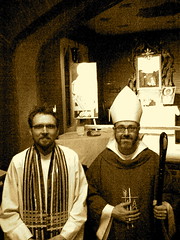
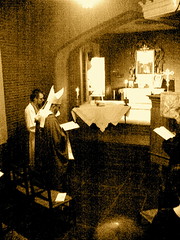
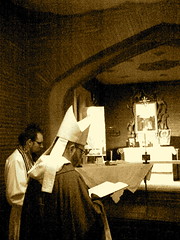
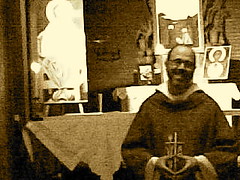
Saturday, February 7
Reflection on Midwinter Covenant Ministers Conference 2009
It has been two years since I last made it to the Covenant Minsters conference Midwinter. The conference was out at the Hyatte O'hare where it has been held for many years until recently. For any unfamiliar with Midwinter, the conference is a denomination wide gathering of Covenant ministers and church staff: pastors, youth ministers, missionaries etc. We gather for a time to worship have continuing education opportunities in the form of workshops, reconnecting, networking and meeting with conference Superintendents.
The conference began with a worship service on Monday evening that I was unable to attend because I was attending an editorial meeting of the Goth Magazine Kilter for which I am submitting an article for the spring issue on Goth Eucharists. The mornings started with a Bible Study with one of the New Testament professors from North Park Theological Seminary Kline Snodgrass, which I did not attend because they were at 8:30 and I did not feel up to getting up early enough to get out to Rosemont by 8:30 each morning. I however, was looking forward to the workshops I had chosen to take and was looking forward to hearing Phyllis Tickle speak at the Tuesday evening worship service.
Tuesday was a sort of surreal day, for a variety of reasons. On one hand I ended up seeing people upon arriving at the Hyatt before my morning workshop who I had not seen in several years. Also, being in one place with alot of pastors is just something I get use to, maybe some day but I find it a little odd even if good. The the two workshops I had were Global Slavery: presented by Dr. Boaz Johnson from North Park University, and then Bridging the communications Gap by Steve Luce Heidi Grieppe and Don Meyer of the department of communications of the covenant. From an evil in the world in part fueled by poverty and deep levels of inequality to talk about internet and electronic forms of communication that requires a certain amount of wealth to have access to this technology. Both were excellent workshops and were relavant to concerns and situations of our congregation. This blog post is partially coming out of the "Communications Gap" workshop as I felt encouraged to post to our blog something more than just sermons and the Reconciler update. Dr. Johnson not only brought awareness to the issue of slavery in our contemporary world but gave me somethings to think about in terms of how Christians might approach issues of injustice in the world, and how to engage a suffering world in ways that face the reality's and are ready for action but also can move beyond paralysis to constructive engagement through what Dr. Johnson called "virtue ethics." Tuesday evening Phyllis Tickle outlined her sense that we are in the midst of a periodic "emergence" where things get shuffled and the foundations of Christianity are reshuffled and rethought. The last such "emergence" was the Reformation 500 years ago. She spoke of some of the ways Scriptures as the world of God are being reconcieved and retrieved both from Modernism both in its secularist and fundamentalist forms. So the first day of the conference was a full day with much I will be reflecting on for sometime.
Wednesday I had one full day workshop, and then Wednesday evening was free time no planed worship or event. The workshop I attended was Spiritual Direction and Pastoral ministry. This workshop was a time to reflect with the presenters some of the main qualities of Spiritual Direction and how they relate and also are indicative of pastoral ministry. We explored together the ways in which spiritual direction overlapped, informed and differed from pastoral ministry. I met a few other pastors who in addition to being pastors also have a spiritual direction ministry. This was a very helpful workshop to clarify my own ministry as spiritual director pastor and prior, and the workshop leaders encouraged seeing more connections and overlap than discontinuity and difference between pastoral ministry and spiritual direction. At lunch on Wednesday I met with a friend and Covenant pastor with whom I have a very long familial connection both our Grandparents were German missionaries sent out by the same mission organization, my Grandparrents in China and his in Japan. After the war both his family and mine were refuges and found their way to the states and when both families came to the states ended up living on the same farm owned by an American sister mission organization who took both families in. Yet beyond our familial connection we have found our own friendship that only solidified as we have entered pastoral ministry and meet up each Midwinter we both are there. Our midwinter conversations over lunch or supper are one of the main things I look forward to in coming to the conference.
Thursday was another all day workshop: Evangelism in the Smaller Church. I will admit that I chose this workshop with some skepticism. I was intrigued by the targeting a workshop on evangelism for small churches and none of the other workshops offered interested me. I was actually pleasantly surprised. The presenter was definitely from a much more conservative and Evangelical place than I am and he was pretty confident in his use of the categories of "saved" and "unsaved", so I felt like a solid universalist by comparison. However, he was aware of the Covenant's theological diversity and was sensitive to the potential differences between he and his audience. Also, basically his sense of evangelism was telling the story and ones own story of Christian faith. I had to do much translating into my own theological stance and language but I was pleasantly surprised very little of substance that I took issue with and I think I might have learned the most from this workshop of the four I attended.
The conference is closed with a breakfast and a final speaker. I sat at a table with my friend Jonathan Wilson, and a number of people I had never met before so had a few tell me about your self exchanges that took most of the breakfast. The speaker was Gary Haugen president and founder of International Justice Mission (IJM). This organization works on fighting slavery and other forms of oppression through providing legal council as well as doing investigative work to provide evidence to aid local law enforcement to enforce laws against slavery etc. and thus involved in rescuing slaves and other oppressed people. The organization also helps support those brought out of slavery or other oppression to get back on their feet and re-enter society being able to support themselves. His message was one of encouraging us as pastors and our churches to become involved in the fullness of witnessing to the Gospel and the Kingdom of God through advocacy and working actively against injustice (specifically slavery). But he also admitted that this can be overwhelming and he used the story of the feeding of the five thousand to remind us that one God just asks that we bring what we have and that God will take care of the miracle. The solution to our paralysis in the face of great evil and injustice is to remember that we are simply called to bring what we have to these situations and God multiplies what we have and works through our small, seemingly insignificant offerings.
It was a good week, book ended by issues of injutice in our world specifically slavery. I was encouraged in my ministry as a pastor and specifically with this congregation and our ecumenical vision and character. In the coming months I hope to share with you all a bit more of some things I learned or became aware of again. I think this time at Midwinter should be able enrich our life together as a congregation. This I think is largely the point of this conference to encourage pastors and provide a place to connect and have friendships with pastors from across the country and to provide pastors with resources to bring back to their congregations for the continued growth of all in the spiritual life.
The conference began with a worship service on Monday evening that I was unable to attend because I was attending an editorial meeting of the Goth Magazine Kilter for which I am submitting an article for the spring issue on Goth Eucharists. The mornings started with a Bible Study with one of the New Testament professors from North Park Theological Seminary Kline Snodgrass, which I did not attend because they were at 8:30 and I did not feel up to getting up early enough to get out to Rosemont by 8:30 each morning. I however, was looking forward to the workshops I had chosen to take and was looking forward to hearing Phyllis Tickle speak at the Tuesday evening worship service.
Tuesday was a sort of surreal day, for a variety of reasons. On one hand I ended up seeing people upon arriving at the Hyatt before my morning workshop who I had not seen in several years. Also, being in one place with alot of pastors is just something I get use to, maybe some day but I find it a little odd even if good. The the two workshops I had were Global Slavery: presented by Dr. Boaz Johnson from North Park University, and then Bridging the communications Gap by Steve Luce Heidi Grieppe and Don Meyer of the department of communications of the covenant. From an evil in the world in part fueled by poverty and deep levels of inequality to talk about internet and electronic forms of communication that requires a certain amount of wealth to have access to this technology. Both were excellent workshops and were relavant to concerns and situations of our congregation. This blog post is partially coming out of the "Communications Gap" workshop as I felt encouraged to post to our blog something more than just sermons and the Reconciler update. Dr. Johnson not only brought awareness to the issue of slavery in our contemporary world but gave me somethings to think about in terms of how Christians might approach issues of injustice in the world, and how to engage a suffering world in ways that face the reality's and are ready for action but also can move beyond paralysis to constructive engagement through what Dr. Johnson called "virtue ethics." Tuesday evening Phyllis Tickle outlined her sense that we are in the midst of a periodic "emergence" where things get shuffled and the foundations of Christianity are reshuffled and rethought. The last such "emergence" was the Reformation 500 years ago. She spoke of some of the ways Scriptures as the world of God are being reconcieved and retrieved both from Modernism both in its secularist and fundamentalist forms. So the first day of the conference was a full day with much I will be reflecting on for sometime.
Wednesday I had one full day workshop, and then Wednesday evening was free time no planed worship or event. The workshop I attended was Spiritual Direction and Pastoral ministry. This workshop was a time to reflect with the presenters some of the main qualities of Spiritual Direction and how they relate and also are indicative of pastoral ministry. We explored together the ways in which spiritual direction overlapped, informed and differed from pastoral ministry. I met a few other pastors who in addition to being pastors also have a spiritual direction ministry. This was a very helpful workshop to clarify my own ministry as spiritual director pastor and prior, and the workshop leaders encouraged seeing more connections and overlap than discontinuity and difference between pastoral ministry and spiritual direction. At lunch on Wednesday I met with a friend and Covenant pastor with whom I have a very long familial connection both our Grandparents were German missionaries sent out by the same mission organization, my Grandparrents in China and his in Japan. After the war both his family and mine were refuges and found their way to the states and when both families came to the states ended up living on the same farm owned by an American sister mission organization who took both families in. Yet beyond our familial connection we have found our own friendship that only solidified as we have entered pastoral ministry and meet up each Midwinter we both are there. Our midwinter conversations over lunch or supper are one of the main things I look forward to in coming to the conference.
Thursday was another all day workshop: Evangelism in the Smaller Church. I will admit that I chose this workshop with some skepticism. I was intrigued by the targeting a workshop on evangelism for small churches and none of the other workshops offered interested me. I was actually pleasantly surprised. The presenter was definitely from a much more conservative and Evangelical place than I am and he was pretty confident in his use of the categories of "saved" and "unsaved", so I felt like a solid universalist by comparison. However, he was aware of the Covenant's theological diversity and was sensitive to the potential differences between he and his audience. Also, basically his sense of evangelism was telling the story and ones own story of Christian faith. I had to do much translating into my own theological stance and language but I was pleasantly surprised very little of substance that I took issue with and I think I might have learned the most from this workshop of the four I attended.
The conference is closed with a breakfast and a final speaker. I sat at a table with my friend Jonathan Wilson, and a number of people I had never met before so had a few tell me about your self exchanges that took most of the breakfast. The speaker was Gary Haugen president and founder of International Justice Mission (IJM). This organization works on fighting slavery and other forms of oppression through providing legal council as well as doing investigative work to provide evidence to aid local law enforcement to enforce laws against slavery etc. and thus involved in rescuing slaves and other oppressed people. The organization also helps support those brought out of slavery or other oppression to get back on their feet and re-enter society being able to support themselves. His message was one of encouraging us as pastors and our churches to become involved in the fullness of witnessing to the Gospel and the Kingdom of God through advocacy and working actively against injustice (specifically slavery). But he also admitted that this can be overwhelming and he used the story of the feeding of the five thousand to remind us that one God just asks that we bring what we have and that God will take care of the miracle. The solution to our paralysis in the face of great evil and injustice is to remember that we are simply called to bring what we have to these situations and God multiplies what we have and works through our small, seemingly insignificant offerings.
It was a good week, book ended by issues of injutice in our world specifically slavery. I was encouraged in my ministry as a pastor and specifically with this congregation and our ecumenical vision and character. In the coming months I hope to share with you all a bit more of some things I learned or became aware of again. I think this time at Midwinter should be able enrich our life together as a congregation. This I think is largely the point of this conference to encourage pastors and provide a place to connect and have friendships with pastors from across the country and to provide pastors with resources to bring back to their congregations for the continued growth of all in the spiritual life.
Monday, February 2
Larry's "office Hours" This Week
I am at the Evangeical Covenant MidWinter Conference for the pastors my denomination. So I will not be at Metropolis on Tuesday Afternoon nor at Ennui Thursday evening.
Also, while I will have the church's cell phone with me sine I will be in meetings and workshops most of the day I will be only able to check for voicemails and texts messages at breaks.
Also, while I will have the church's cell phone with me sine I will be in meetings and workshops most of the day I will be only able to check for voicemails and texts messages at breaks.
Subscribe to:
Posts (Atom)